

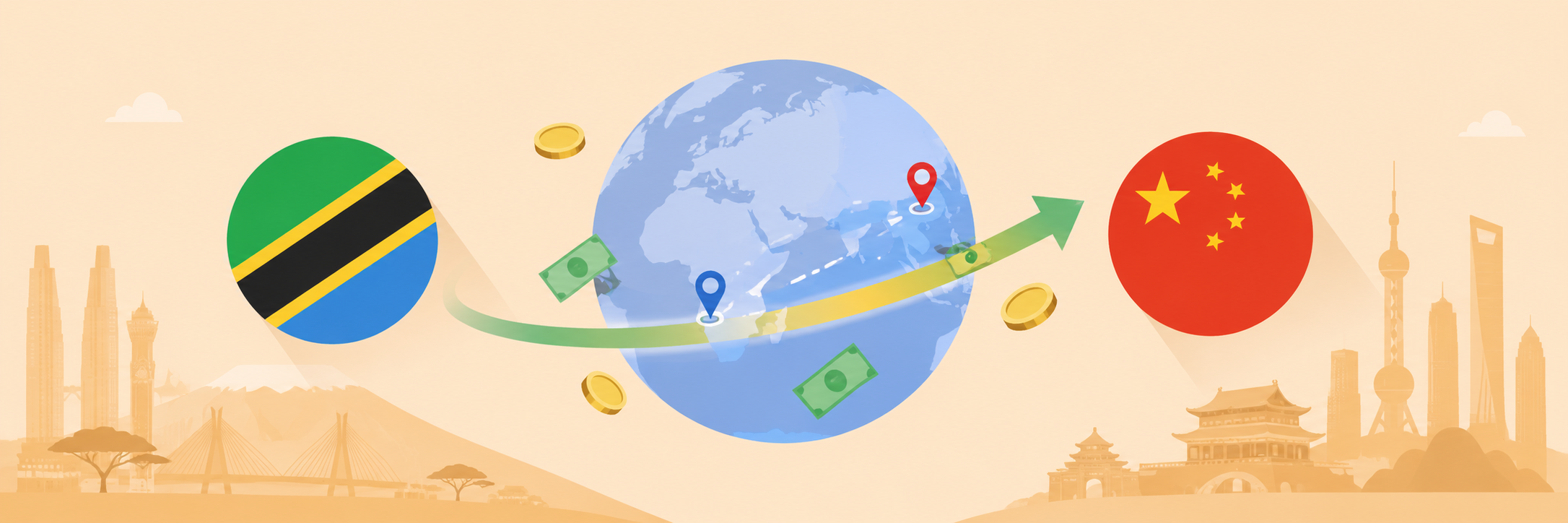

A friend of mine runs a textiles business in Dar es Salaam. She imports fabric from Guangzhou twice a year, and every single time, the same conversation happens: her supplier asks when the money is coming, she calls her bank, and then she waits. Three days. Sometimes five. And in that window, her supplier's warehouse slot may or may not still be available.
She's not unusual. Tanzania and China have one of the most active trade relationships in East Africa. Chinese goods flow into Tanzania in enormous volumes, from electronics and machinery to clothing, building materials, and consumer goods. The money flowing back the other direction, the payments Tanzanian businesses and individuals need to make, is a problem that too many people are still solving with a bank queue and a prayer.
This is what I wish had existed when she first started asking.
Why Tanzania-China Transfers Feel Harder Than They Should
Tanzania and China have traded with each other for decades. China is consistently among Tanzania's top trading partners, and the relationship has deepened significantly with Belt and Road investment in ports, roads, and energy infrastructure. Yet when a Tanzanian business owner needs to wire money to a supplier in Shenzhen or Chengdu, the financial infrastructure hasn't kept up with the trade relationship.
Part of this is structural. The Tanzanian shilling (TZS) is not a freely traded international currency. That means every payment to China involves at least two conversions: TZS to USD, then USD to Chinese yuan (CNY). Each conversion is an opportunity for a bank to extract margin. By the time your money arrives, you may have lost three to five percent of the transfer value in fees and unfavorable exchange rates, on top of flat fees that can run from $15 to $45 per wire.
The other part is regulatory. Tanzania has foreign exchange controls that govern how much you can send abroad and what documentation you need. For personal transfers and business payments, your bank will typically require proof of the underlying transaction: an invoice, a purchase order, a contract. This slows things down even before the actual wire has been initiated.
None of this is a dead end. But you fix friction more effectively once you understand where it comes from.
What You Need Before You Start
Regardless of which method you use, there is some paperwork you should have ready before you initiate a transfer to China.
For business payments, your Chinese supplier should give you their full bank details: the bank name, the branch address, the account number, and the SWIFT/BIC code. Most major Chinese banks (Bank of China, ICBC, China Construction Bank) have SWIFT codes and can receive international wires. Some smaller suppliers use accounts with regional banks that require more specific routing information, so confirm with your supplier before you start.
For personal transfers, the recipient's full name must match their bank account exactly. China's banking system is strict about name matching, and a mismatch can cause a wire to bounce back, with fees deducted on both ends.
Your own documentation: if you're sending from a Tanzanian bank, have your invoice or proof of payment ready. If you're using a digital transfer service, you'll typically need a government-issued ID and sometimes proof of the purpose of transfer for larger amounts.
The Main Options Available to You
Traditional Bank Wire
This is what most Tanzanian businesses default to, and I understand why. It feels familiar. Your relationship manager knows you. The bank exists. But I want to be honest about the cost.
Bank wires from Tanzania to China typically take three to five business days. Fees on the Tanzanian side alone can run between $20 and $45 for the outgoing wire, and Chinese receiving banks sometimes charge their own receiving fee on top. The exchange rate you get from a Tanzanian commercial bank is rarely close to the mid-market rate, the actual rate you see on Google. The bank's margin is usually built into the rate itself, often one to two percent.
For occasional large transfers where the paperwork trail matters for compliance or import documentation, bank wire makes sense. For frequent supplier payments, the cumulative cost is a serious drag on your margins.
Digital Money Transfer Services
The past several years have brought genuinely useful options that were not available a decade ago. Wise (formerly TransferWise) offers transfers from Tanzania to China using the mid-market exchange rate and charges a transparent fee upfront. The fee is higher in percentage terms than a wire for large amounts, but the rate is better, and you know exactly what you're paying before you send.
WorldRemit and Western Union both support Tanzania-to-China transfers, with varying speeds and delivery options. For WorldRemit, transfers typically land in one to two business days via bank deposit. Western Union has a cash pickup option in China, which is useful if your recipient doesn't have a bank account or prefers cash for smaller amounts.
For B2B payments where your Chinese supplier needs a bank deposit, Wise or WorldRemit are generally the most cost-effective combination of rate and speed I've seen for this corridor.
What About WeChat Pay or Alipay?
I get this question a lot. Chinese consumers use WeChat Pay and Alipay for nearly everything domestically. But for international payments from Tanzania, these platforms have significant restrictions for foreign senders. Linking a Tanzanian account to WeChat Pay requires a verified Chinese phone number and often a Chinese bank card. These are steps that are practically impossible for most Tanzanian senders. Some traders get around this by having a trusted person in China receive a bank transfer and then pay the supplier via WeChat on their behalf, but that introduces its own risks.
For now, I'd treat WeChat Pay and Alipay as local Chinese tools, not international payment rails for Tanzanian senders.
The Exchange Rate Question
On rates: the number a service shows you should be the number you pay. My habit is to cross-check whatever rate a bank or app is quoting against xe.com or Google's live exchange rate, then calculate what percentage the service is taking as margin. Anything above two percent is worth questioning, especially on amounts over $1,000.
One thing that catches people off guard on Tanzania-China transfers is that some services quote TZS to USD, then USD to CNY as two separate steps, but only show you the final CNY amount. The combined rate may look fine until you do the math on what you actually sent in shillings. Always calculate from shillings to yuan end-to-end.
The Tanzanian shilling has been relatively stable against the US dollar over the past year, which actually helps. You're not fighting exchange rate volatility in the way you would with the Ghanaian cedi or the Nigerian naira, both of which have had significant depreciation pressure. But stable doesn't mean cheap, and the cross-currency spread on TZS-to-CNY is still meaningful.
For Businesses Sending Regularly
If you are importing from China on any kind of regular basis, monthly or quarterly orders from the same suppliers, it is worth setting up a proper system rather than treating each payment as a one-off transaction.
Opening a USD account at a Tanzanian bank, if you can qualify for one, lets you receive dollar invoices and hold dollars before sending them to China. This removes one currency conversion (TZS to USD) from the equation and gives you more control over when you convert. The USD-to-CNY leg is more efficient than TZS-to-USD-to-CNY routed through a bank.
Some businesses also negotiate with their Chinese suppliers to accept partial payment via faster digital routes and the remainder via bank wire when the goods ship. Splitting a payment is unusual but not unheard of, and it can reduce the window of float where your money is in transit but no goods are moving.
We built Afriex to make these kinds of transfers simpler for African businesses and diaspora, including corridors like this one, though I'd encourage you to compare options and find what fits your specific situation, supplier requirements, and amounts.
A Note on Transfer Limits
Transfer limits are worth understanding before you build a payment cycle around a service. Tanzania's foreign exchange regulations mean that larger transfers above certain thresholds require additional documentation and sometimes Bank of Tanzania approvals. Your bank or transfer service can tell you the specific limits that apply to your account type and transfer purpose.
Digital transfer services like Wise also have their own per-transaction and monthly limits. For a business sending $5,000 to $20,000 per month to Chinese suppliers, these limits are usually not a problem, but confirm before you start. For imports at the scale where you're talking about six-figure shipments, you'll likely need your bank's trade finance desk regardless.
What Actually Matters
My friend figured this out after her third or fourth shipment. The fix that made the biggest difference wasn't finding some magic payment app. It was understanding exactly what her supplier needed (bank name, account number, SWIFT code, beneficiary address) and having that information ready before she started the transfer, not after. It was knowing which service gave her the best TZS-to-CNY rate for her typical transfer size. And it was sending two to three days before her supplier's payment deadline, not on the day.
Payment systems between Tanzania and China are genuinely less developed than between, say, Nigeria and China or Kenya and the Gulf states. But the options that exist are better than they were five years ago, and they continue to improve as digital money transfer infrastructure expands across East Africa.
The core advice is simple: compare the end-to-end rate, not just the headline fee. Get your supplier's full banking details before you start, not after. Send two or three days early. And if you're paying the same supplier every quarter with a bank wire, stop. There is almost certainly a cheaper and faster option waiting. Most people leave it on the table because switching feels like admin. It isn't. It's money.



.svg)
.svg)
.svg)
.svg)
.svg)
.svg)
.svg)
.svg)
.svg)
.svg)
.svg)
.svg)
.svg)
.svg)
.svg)
.svg)
.svg)
.svg)
.svg)
.svg)
.svg)
.svg)
.svg)
.svg)
.svg)
.svg)
.svg)
.svg)
.svg)
.svg)
.svg)
.svg)
.svg)
.svg)
.svg)
.svg)
.svg)
.svg)
.svg)
.svg)
.svg)
.svg)
.svg)
.svg)
.svg)
.svg)


.png)

.png)