Afriex Insights

How to Send Money from Nigeria to Belgium

Read Time
read
TABLE OF CONTENT (we use H2, H3, H4)
Subscribe to the Afriex newsletter
Thank you! Your submission has been received!
Oops! Something went wrong while submitting the form.

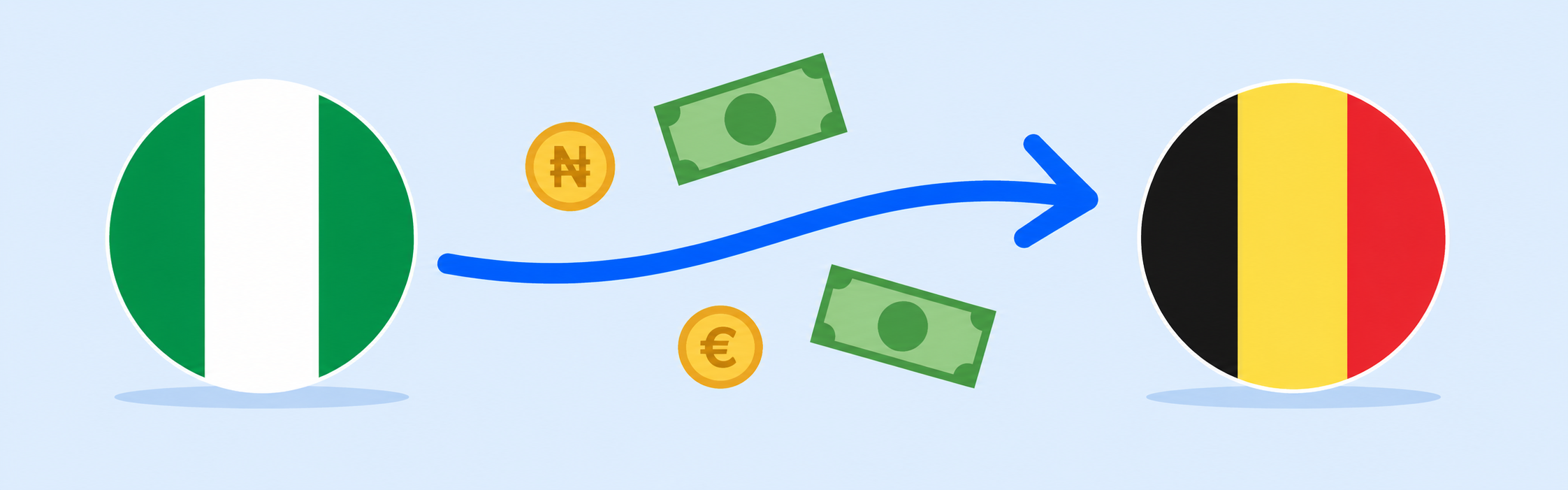
Belgium rarely comes up in conversations about the Nigerian diaspora. The UK, Italy, Canada: those dominate the conversation. But Belgium has a quiet and substantial Nigerian presence, and for the tens of thousands of Nigerians between Brussels and Antwerp, the question of how to send money back and forth is one that comes up constantly, and the answers are worse than they should be.

I have been watching this corridor closely. It hits almost every pain point that makes African diaspora transfers difficult: currency controls on the Nigerian side, EU AML compliance on the Belgian side, and a market that the big international remittance brands have never fully optimized for. The result is that most Nigerians in Belgium are either overpaying through their bank or relying on services built for a different audience. This post is my attempt to give you a proper walkthrough.

Why Nigerians in Belgium Are a Bigger Community Than You Think

The Belgian context matters. Brussels is home to the EU institutions (the European Commission, the European Parliament, the Council of the EU) and attracts African professionals working in diplomacy, NGOs, international development, and policy. Antwerp is one of the world's major diamond trade hubs, and West African traders have been part of that ecosystem for decades. Add the university students at KU Leuven, Vrije Universiteit Brussel, and Universiteit Antwerpen, and you have a Nigerian community that is educated, economically active, and regularly sending money between Nigeria and Belgium in both directions.

My estimate, based on migration data, is that at least 20,000 Nigerians live in Belgium at any given time, likely more when you account for students on temporary visas and undocumented residents. That is a meaningful corridor, and it is systematically underserved by the mainstream transfer industry.

The Structural Problems With This Corridor

On the surface, Nigeria to Belgium should be easy. Both countries have functional banking systems and both are connected to SWIFT. Belgium uses the euro, which is among the most liquid currencies in the world.

The friction is not technical. It is regulatory and structural on both sides.

From the Nigerian side, the Central Bank of Nigeria has placed significant restrictions on outbound foreign exchange over the last several years. Sending money internationally from a Nigerian bank account requires proper documentation of purpose (education, medical, family support, business), and some banks are more cooperative than others in processing these requests. The permitted annual forex allocation for individuals has changed multiple times, and the rules are not uniformly applied across banks. What this means in practice is that a straightforward transfer request can stall for days at a local bank branch while the officer figures out what approval is required.

From the Belgian side, the country operates under strict EU Anti-Money Laundering regulations, and Belgium's financial intelligence unit (CTIF-CFI) pays close attention to incoming transfers from West Africa. Transfers above certain thresholds get additional scrutiny. This is not a barrier to legitimate transfers, but it means using a properly regulated service matters here more than it might in other corridors.

What the Nigerian Community in Belgium Actually Uses

When I look at how people actually navigate this corridor, the pattern falls into roughly three groups.

The first group relies on Western Union and MoneyGram, particularly for sending money from Belgium to Nigeria. The reason is familiarity. The recipients in Nigeria know how to pick up Western Union, and it works without requiring a bank account. The cost, though, is real. On a 300 euro transfer, you can easily lose 20 to 30 euros in fees and exchange rate spread. Over twelve months, that number accumulates into something significant.

The second group uses their Belgian bank to send directly. ING Belgium, KBC, BNP Paribas Fortis, and Belfius all process SWIFT international transfers, and a Nigerian bank account receiving a SWIFT wire is standard procedure. The problem is cost at both ends. The sending Belgian bank charges outbound transfer fees of 20 to 35 euros per transaction depending on the amount and speed. The receiving Nigerian bank often charges its own fee on inbound international transfers. And neither of those fees includes the exchange rate margin that the bank takes as profit, which is typically 1.5 to 3 percent above the mid-market rate.

The third group, and these are the people who have figured it out, uses digital transfer platforms that specialize in corridors like Nigeria-Belgium. Wise, Remitly, and Afriex all serve this route and offer materially better outcomes than a bank wire.

The Real Comparison: What Each Option Costs You

Let me be concrete, because vague descriptions of "lower fees" are not useful when you are trying to decide where to send 500 euros.

Bank wire transfers are the most expensive option for most transfer sizes. For amounts below 2,000 euros, the flat fee plus rate margin almost always makes this the worst choice. Where bank wires make sense is for very large amounts, above 5,000 euros, where the percentage-based fee structures of digital platforms start to approach what a bank charges in flat fees.

Western Union and MoneyGram retain a use case specifically when cash pickup at a Nigerian agent location is the delivery method. If your recipient does not have a bank account, these services are reliable. If they do have a bank account, you are paying a premium for a delivery method you do not need.

Wise is one of the most transparent options in this corridor. The platform shows you the mid-market EUR/NGN rate, tells you the fee upfront, and shows the exact naira amount the recipient will receive before you confirm. The limitation is that delivery is bank account to bank account, and in my experience the processing time for first-time transfers is occasionally longer than advertised while identity verification completes.

Remitly covers this corridor with competitive pricing and a mobile-first experience that works well for regular transfers. Speed and rate offers vary by time of day, so checking mid-week during business hours often yields the best available rates.

Afriex was built specifically with the African diaspora in mind, and the Nigeria-Belgium corridor is one we have worked to make competitive. My honest recommendation, as always, is to compare. Pull up the EUR/NGN rate on XE.com or Wise, then check what Afriex and Remitly are each offering for the same amount on the same day. The received naira amount is the number that tells you everything. I'd encourage you to run that comparison across at least two services before committing to a routine.

What to Have Ready Before You Transfer

This is the part that trips people up, and delays happen because of missing information rather than anything wrong with the transfer itself.

To send money to a Nigerian bank account from Belgium, you need: the recipient's full legal name exactly as registered on their bank account, the 10-digit NUBAN account number, the bank name, and the bank's SWIFT/BIC code. The name match matters enormously for Nigerian bank transfers. A nickname, a shortened version of a middle name, or an initial where a full name is expected can cause the bank to hold or return the transfer. Check the recipient's bank card or account statement and copy the name exactly.

For transfers above 1,000 euros, Belgian banks and regulated transfer services operating under EU rules may ask you to state the purpose. "Family support" is a recognized and accepted category. "Education fees" works for student support. Have a brief description ready. It keeps the process moving without additional back-and-forth.

For transfers originating in Nigeria to Belgium, the primary challenge is the forex access. The most reliable approach is to use a licensed International Money Transfer Operator (IMTO) that is registered with the CBN and operates within the approved framework. These services can access foreign exchange and process the transfer through legitimate channels. Trying to do this through an informal arrangement because it seems faster or cheaper is a risk that is genuinely not worth taking. The exposure to loss is real, and there is no recourse.

Tracking the EUR/NGN Exchange Rate

The exchange rate between the euro and the naira is where real money disappears without people realizing it, and it has been more volatile over the last three years than most Nigerians sending regular support had planned for.

My habit, and one I share with anyone who transfers money regularly, is to check the mid-market EUR/NGN rate on XE.com before initiating any transfer. The mid-market rate is the baseline. It is what the currency markets are actually trading at. Every transfer service applies a margin to that rate as their profit. Knowing the baseline tells you whether a particular service's offer on a given day is reasonable or expensive.

The practical implication for people sending regular support from Belgium to Nigeria: if you have a naira amount in mind as the monthly support target, work backward from the EUR/NGN rate to figure out how many euros to send. Do not work forward from a fixed euro amount, because the naira amount arriving will vary with the rate. A 200 euro transfer that delivered 320,000 naira six months ago might deliver 290,000 naira today if the rate has moved.

For Business Transfers

The Nigeria-Belgium corridor also includes a meaningful volume of business payments: small importers in Lagos paying Belgian companies for goods, Nigerian consultants billing EU-based clients, professionals receiving salary payments from Belgian employers into Nigerian accounts.

For business transfers, the compliance requirements are higher and worth understanding in advance. Belgian companies sending payment to Nigeria will typically require a formal invoice and may need to classify the payment in their accounting. Nigerian businesses receiving payments from Belgium should work with a bank or transfer service that can issue a proper inbound remittance certificate, which is useful for Nigerian tax documentation.

The size of the transfer matters here. For amounts above 10,000 euros, both Belgian and Nigerian financial institutions have additional reporting requirements. These are manageable with proper documentation. They are not barriers to the transfer. But walking into the process unprepared adds unnecessary time.

Closing

The Nigeria-Belgium corridor is one of those routes that works well when you understand it, and causes unnecessary friction and expense when you do not. The community of Nigerians in Belgium is real, active, and regularly moving money across this corridor. The tools to do it cheaply and efficiently exist today.

The thing I see most often is people using their bank out of habit because that is what they have always done. Compare that bank rate against what a digital platform offers for the same transfer. Do it once. The number you see will likely be enough to change your routine.

Subscribe to the Afriex newsletter
Thank you! Your submission has been received!
Oops! Something went wrong while submitting the form.
TABLE OF CONTENT
Subscribe to our newsletter
Read about our privacy policy.
Thank you! Your submission has been received!
Oops! Something went wrong while submitting the form.

Belgium rarely comes up in conversations about the Nigerian diaspora. The UK, Italy, Canada: those dominate the conversation. But Belgium has a quiet and substantial Nigerian presence, and for the tens of thousands of Nigerians between Brussels and Antwerp, the question of how to send money back and forth is one that comes up constantly, and the answers are worse than they should be.

I have been watching this corridor closely. It hits almost every pain point that makes African diaspora transfers difficult: currency controls on the Nigerian side, EU AML compliance on the Belgian side, and a market that the big international remittance brands have never fully optimized for. The result is that most Nigerians in Belgium are either overpaying through their bank or relying on services built for a different audience. This post is my attempt to give you a proper walkthrough.

Why Nigerians in Belgium Are a Bigger Community Than You Think

The Belgian context matters. Brussels is home to the EU institutions (the European Commission, the European Parliament, the Council of the EU) and attracts African professionals working in diplomacy, NGOs, international development, and policy. Antwerp is one of the world's major diamond trade hubs, and West African traders have been part of that ecosystem for decades. Add the university students at KU Leuven, Vrije Universiteit Brussel, and Universiteit Antwerpen, and you have a Nigerian community that is educated, economically active, and regularly sending money between Nigeria and Belgium in both directions.

My estimate, based on migration data, is that at least 20,000 Nigerians live in Belgium at any given time, likely more when you account for students on temporary visas and undocumented residents. That is a meaningful corridor, and it is systematically underserved by the mainstream transfer industry.

The Structural Problems With This Corridor

On the surface, Nigeria to Belgium should be easy. Both countries have functional banking systems and both are connected to SWIFT. Belgium uses the euro, which is among the most liquid currencies in the world.

The friction is not technical. It is regulatory and structural on both sides.

From the Nigerian side, the Central Bank of Nigeria has placed significant restrictions on outbound foreign exchange over the last several years. Sending money internationally from a Nigerian bank account requires proper documentation of purpose (education, medical, family support, business), and some banks are more cooperative than others in processing these requests. The permitted annual forex allocation for individuals has changed multiple times, and the rules are not uniformly applied across banks. What this means in practice is that a straightforward transfer request can stall for days at a local bank branch while the officer figures out what approval is required.

From the Belgian side, the country operates under strict EU Anti-Money Laundering regulations, and Belgium's financial intelligence unit (CTIF-CFI) pays close attention to incoming transfers from West Africa. Transfers above certain thresholds get additional scrutiny. This is not a barrier to legitimate transfers, but it means using a properly regulated service matters here more than it might in other corridors.

What the Nigerian Community in Belgium Actually Uses

When I look at how people actually navigate this corridor, the pattern falls into roughly three groups.

The first group relies on Western Union and MoneyGram, particularly for sending money from Belgium to Nigeria. The reason is familiarity. The recipients in Nigeria know how to pick up Western Union, and it works without requiring a bank account. The cost, though, is real. On a 300 euro transfer, you can easily lose 20 to 30 euros in fees and exchange rate spread. Over twelve months, that number accumulates into something significant.

The second group uses their Belgian bank to send directly. ING Belgium, KBC, BNP Paribas Fortis, and Belfius all process SWIFT international transfers, and a Nigerian bank account receiving a SWIFT wire is standard procedure. The problem is cost at both ends. The sending Belgian bank charges outbound transfer fees of 20 to 35 euros per transaction depending on the amount and speed. The receiving Nigerian bank often charges its own fee on inbound international transfers. And neither of those fees includes the exchange rate margin that the bank takes as profit, which is typically 1.5 to 3 percent above the mid-market rate.

The third group, and these are the people who have figured it out, uses digital transfer platforms that specialize in corridors like Nigeria-Belgium. Wise, Remitly, and Afriex all serve this route and offer materially better outcomes than a bank wire.

The Real Comparison: What Each Option Costs You

Let me be concrete, because vague descriptions of "lower fees" are not useful when you are trying to decide where to send 500 euros.

Bank wire transfers are the most expensive option for most transfer sizes. For amounts below 2,000 euros, the flat fee plus rate margin almost always makes this the worst choice. Where bank wires make sense is for very large amounts, above 5,000 euros, where the percentage-based fee structures of digital platforms start to approach what a bank charges in flat fees.

Western Union and MoneyGram retain a use case specifically when cash pickup at a Nigerian agent location is the delivery method. If your recipient does not have a bank account, these services are reliable. If they do have a bank account, you are paying a premium for a delivery method you do not need.

Wise is one of the most transparent options in this corridor. The platform shows you the mid-market EUR/NGN rate, tells you the fee upfront, and shows the exact naira amount the recipient will receive before you confirm. The limitation is that delivery is bank account to bank account, and in my experience the processing time for first-time transfers is occasionally longer than advertised while identity verification completes.

Remitly covers this corridor with competitive pricing and a mobile-first experience that works well for regular transfers. Speed and rate offers vary by time of day, so checking mid-week during business hours often yields the best available rates.

Afriex was built specifically with the African diaspora in mind, and the Nigeria-Belgium corridor is one we have worked to make competitive. My honest recommendation, as always, is to compare. Pull up the EUR/NGN rate on XE.com or Wise, then check what Afriex and Remitly are each offering for the same amount on the same day. The received naira amount is the number that tells you everything. I'd encourage you to run that comparison across at least two services before committing to a routine.

What to Have Ready Before You Transfer

This is the part that trips people up, and delays happen because of missing information rather than anything wrong with the transfer itself.

To send money to a Nigerian bank account from Belgium, you need: the recipient's full legal name exactly as registered on their bank account, the 10-digit NUBAN account number, the bank name, and the bank's SWIFT/BIC code. The name match matters enormously for Nigerian bank transfers. A nickname, a shortened version of a middle name, or an initial where a full name is expected can cause the bank to hold or return the transfer. Check the recipient's bank card or account statement and copy the name exactly.

For transfers above 1,000 euros, Belgian banks and regulated transfer services operating under EU rules may ask you to state the purpose. "Family support" is a recognized and accepted category. "Education fees" works for student support. Have a brief description ready. It keeps the process moving without additional back-and-forth.

For transfers originating in Nigeria to Belgium, the primary challenge is the forex access. The most reliable approach is to use a licensed International Money Transfer Operator (IMTO) that is registered with the CBN and operates within the approved framework. These services can access foreign exchange and process the transfer through legitimate channels. Trying to do this through an informal arrangement because it seems faster or cheaper is a risk that is genuinely not worth taking. The exposure to loss is real, and there is no recourse.

Tracking the EUR/NGN Exchange Rate

The exchange rate between the euro and the naira is where real money disappears without people realizing it, and it has been more volatile over the last three years than most Nigerians sending regular support had planned for.

My habit, and one I share with anyone who transfers money regularly, is to check the mid-market EUR/NGN rate on XE.com before initiating any transfer. The mid-market rate is the baseline. It is what the currency markets are actually trading at. Every transfer service applies a margin to that rate as their profit. Knowing the baseline tells you whether a particular service's offer on a given day is reasonable or expensive.

The practical implication for people sending regular support from Belgium to Nigeria: if you have a naira amount in mind as the monthly support target, work backward from the EUR/NGN rate to figure out how many euros to send. Do not work forward from a fixed euro amount, because the naira amount arriving will vary with the rate. A 200 euro transfer that delivered 320,000 naira six months ago might deliver 290,000 naira today if the rate has moved.

For Business Transfers

The Nigeria-Belgium corridor also includes a meaningful volume of business payments: small importers in Lagos paying Belgian companies for goods, Nigerian consultants billing EU-based clients, professionals receiving salary payments from Belgian employers into Nigerian accounts.

For business transfers, the compliance requirements are higher and worth understanding in advance. Belgian companies sending payment to Nigeria will typically require a formal invoice and may need to classify the payment in their accounting. Nigerian businesses receiving payments from Belgium should work with a bank or transfer service that can issue a proper inbound remittance certificate, which is useful for Nigerian tax documentation.

The size of the transfer matters here. For amounts above 10,000 euros, both Belgian and Nigerian financial institutions have additional reporting requirements. These are manageable with proper documentation. They are not barriers to the transfer. But walking into the process unprepared adds unnecessary time.

Closing

The Nigeria-Belgium corridor is one of those routes that works well when you understand it, and causes unnecessary friction and expense when you do not. The community of Nigerians in Belgium is real, active, and regularly moving money across this corridor. The tools to do it cheaply and efficiently exist today.

The thing I see most often is people using their bank out of habit because that is what they have always done. Compare that bank rate against what a digital platform offers for the same transfer. Do it once. The number you see will likely be enough to change your routine.

Text Link

Lorem ipsum dolor sit amet, consectetur adipiscing elit. Suspendisse varius enim in eros elementum tristique. Duis cursus, mi quis viverra ornare, eros dolor interdum nulla, ut commodo diam libero vitae erat. Aenean faucibus nibh et justo cursus id rutrum lorem imperdiet. Nunc ut sem vitae risus tristique posuere.

Belgium rarely comes up in conversations about the Nigerian diaspora. The UK, Italy, Canada: those dominate the conversation. But Belgium has a quiet and substantial Nigerian presence, and for the tens of thousands of Nigerians between Brussels and Antwerp, the question of how to send money back and forth is one that comes up constantly, and the answers are worse than they should be.

I have been watching this corridor closely. It hits almost every pain point that makes African diaspora transfers difficult: currency controls on the Nigerian side, EU AML compliance on the Belgian side, and a market that the big international remittance brands have never fully optimized for. The result is that most Nigerians in Belgium are either overpaying through their bank or relying on services built for a different audience. This post is my attempt to give you a proper walkthrough.

Why Nigerians in Belgium Are a Bigger Community Than You Think

The Belgian context matters. Brussels is home to the EU institutions (the European Commission, the European Parliament, the Council of the EU) and attracts African professionals working in diplomacy, NGOs, international development, and policy. Antwerp is one of the world's major diamond trade hubs, and West African traders have been part of that ecosystem for decades. Add the university students at KU Leuven, Vrije Universiteit Brussel, and Universiteit Antwerpen, and you have a Nigerian community that is educated, economically active, and regularly sending money between Nigeria and Belgium in both directions.

My estimate, based on migration data, is that at least 20,000 Nigerians live in Belgium at any given time, likely more when you account for students on temporary visas and undocumented residents. That is a meaningful corridor, and it is systematically underserved by the mainstream transfer industry.

The Structural Problems With This Corridor

On the surface, Nigeria to Belgium should be easy. Both countries have functional banking systems and both are connected to SWIFT. Belgium uses the euro, which is among the most liquid currencies in the world.

The friction is not technical. It is regulatory and structural on both sides.

From the Nigerian side, the Central Bank of Nigeria has placed significant restrictions on outbound foreign exchange over the last several years. Sending money internationally from a Nigerian bank account requires proper documentation of purpose (education, medical, family support, business), and some banks are more cooperative than others in processing these requests. The permitted annual forex allocation for individuals has changed multiple times, and the rules are not uniformly applied across banks. What this means in practice is that a straightforward transfer request can stall for days at a local bank branch while the officer figures out what approval is required.

From the Belgian side, the country operates under strict EU Anti-Money Laundering regulations, and Belgium's financial intelligence unit (CTIF-CFI) pays close attention to incoming transfers from West Africa. Transfers above certain thresholds get additional scrutiny. This is not a barrier to legitimate transfers, but it means using a properly regulated service matters here more than it might in other corridors.

What the Nigerian Community in Belgium Actually Uses

When I look at how people actually navigate this corridor, the pattern falls into roughly three groups.

The first group relies on Western Union and MoneyGram, particularly for sending money from Belgium to Nigeria. The reason is familiarity. The recipients in Nigeria know how to pick up Western Union, and it works without requiring a bank account. The cost, though, is real. On a 300 euro transfer, you can easily lose 20 to 30 euros in fees and exchange rate spread. Over twelve months, that number accumulates into something significant.

The second group uses their Belgian bank to send directly. ING Belgium, KBC, BNP Paribas Fortis, and Belfius all process SWIFT international transfers, and a Nigerian bank account receiving a SWIFT wire is standard procedure. The problem is cost at both ends. The sending Belgian bank charges outbound transfer fees of 20 to 35 euros per transaction depending on the amount and speed. The receiving Nigerian bank often charges its own fee on inbound international transfers. And neither of those fees includes the exchange rate margin that the bank takes as profit, which is typically 1.5 to 3 percent above the mid-market rate.

The third group, and these are the people who have figured it out, uses digital transfer platforms that specialize in corridors like Nigeria-Belgium. Wise, Remitly, and Afriex all serve this route and offer materially better outcomes than a bank wire.

The Real Comparison: What Each Option Costs You

Let me be concrete, because vague descriptions of "lower fees" are not useful when you are trying to decide where to send 500 euros.

Bank wire transfers are the most expensive option for most transfer sizes. For amounts below 2,000 euros, the flat fee plus rate margin almost always makes this the worst choice. Where bank wires make sense is for very large amounts, above 5,000 euros, where the percentage-based fee structures of digital platforms start to approach what a bank charges in flat fees.

Western Union and MoneyGram retain a use case specifically when cash pickup at a Nigerian agent location is the delivery method. If your recipient does not have a bank account, these services are reliable. If they do have a bank account, you are paying a premium for a delivery method you do not need.

Wise is one of the most transparent options in this corridor. The platform shows you the mid-market EUR/NGN rate, tells you the fee upfront, and shows the exact naira amount the recipient will receive before you confirm. The limitation is that delivery is bank account to bank account, and in my experience the processing time for first-time transfers is occasionally longer than advertised while identity verification completes.

Remitly covers this corridor with competitive pricing and a mobile-first experience that works well for regular transfers. Speed and rate offers vary by time of day, so checking mid-week during business hours often yields the best available rates.

Afriex was built specifically with the African diaspora in mind, and the Nigeria-Belgium corridor is one we have worked to make competitive. My honest recommendation, as always, is to compare. Pull up the EUR/NGN rate on XE.com or Wise, then check what Afriex and Remitly are each offering for the same amount on the same day. The received naira amount is the number that tells you everything. I'd encourage you to run that comparison across at least two services before committing to a routine.

What to Have Ready Before You Transfer

This is the part that trips people up, and delays happen because of missing information rather than anything wrong with the transfer itself.

To send money to a Nigerian bank account from Belgium, you need: the recipient's full legal name exactly as registered on their bank account, the 10-digit NUBAN account number, the bank name, and the bank's SWIFT/BIC code. The name match matters enormously for Nigerian bank transfers. A nickname, a shortened version of a middle name, or an initial where a full name is expected can cause the bank to hold or return the transfer. Check the recipient's bank card or account statement and copy the name exactly.

For transfers above 1,000 euros, Belgian banks and regulated transfer services operating under EU rules may ask you to state the purpose. "Family support" is a recognized and accepted category. "Education fees" works for student support. Have a brief description ready. It keeps the process moving without additional back-and-forth.

For transfers originating in Nigeria to Belgium, the primary challenge is the forex access. The most reliable approach is to use a licensed International Money Transfer Operator (IMTO) that is registered with the CBN and operates within the approved framework. These services can access foreign exchange and process the transfer through legitimate channels. Trying to do this through an informal arrangement because it seems faster or cheaper is a risk that is genuinely not worth taking. The exposure to loss is real, and there is no recourse.

Tracking the EUR/NGN Exchange Rate

The exchange rate between the euro and the naira is where real money disappears without people realizing it, and it has been more volatile over the last three years than most Nigerians sending regular support had planned for.

My habit, and one I share with anyone who transfers money regularly, is to check the mid-market EUR/NGN rate on XE.com before initiating any transfer. The mid-market rate is the baseline. It is what the currency markets are actually trading at. Every transfer service applies a margin to that rate as their profit. Knowing the baseline tells you whether a particular service's offer on a given day is reasonable or expensive.

The practical implication for people sending regular support from Belgium to Nigeria: if you have a naira amount in mind as the monthly support target, work backward from the EUR/NGN rate to figure out how many euros to send. Do not work forward from a fixed euro amount, because the naira amount arriving will vary with the rate. A 200 euro transfer that delivered 320,000 naira six months ago might deliver 290,000 naira today if the rate has moved.

For Business Transfers

The Nigeria-Belgium corridor also includes a meaningful volume of business payments: small importers in Lagos paying Belgian companies for goods, Nigerian consultants billing EU-based clients, professionals receiving salary payments from Belgian employers into Nigerian accounts.

For business transfers, the compliance requirements are higher and worth understanding in advance. Belgian companies sending payment to Nigeria will typically require a formal invoice and may need to classify the payment in their accounting. Nigerian businesses receiving payments from Belgium should work with a bank or transfer service that can issue a proper inbound remittance certificate, which is useful for Nigerian tax documentation.

The size of the transfer matters here. For amounts above 10,000 euros, both Belgian and Nigerian financial institutions have additional reporting requirements. These are manageable with proper documentation. They are not barriers to the transfer. But walking into the process unprepared adds unnecessary time.

Closing

The Nigeria-Belgium corridor is one of those routes that works well when you understand it, and causes unnecessary friction and expense when you do not. The community of Nigerians in Belgium is real, active, and regularly moving money across this corridor. The tools to do it cheaply and efficiently exist today.

The thing I see most often is people using their bank out of habit because that is what they have always done. Compare that bank rate against what a digital platform offers for the same transfer. Do it once. The number you see will likely be enough to change your routine.

Related Articles

No items found.

Heading 1

Heading 2

Heading 3

Heading 4

Heading 5
Heading 6

Lorem ipsum dolor sit amet, consectetur adipiscing elit, sed do eiusmod tempor incididunt ut labore et dolore magna aliqua. Ut enim ad minim veniam, quis nostrud exercitation ullamco laboris nisi ut aliquip ex ea commodo consequat. Duis aute irure dolor in reprehenderit in voluptate velit esse cillum dolore eu fugiat nulla pariatur.

Block quote

Ordered list

  1. Item 1
  2. Item 2
  3. Item 3

Unordered list

Text link

Bold text

Emphasis

Superscript

Subscript