Afriex Insights

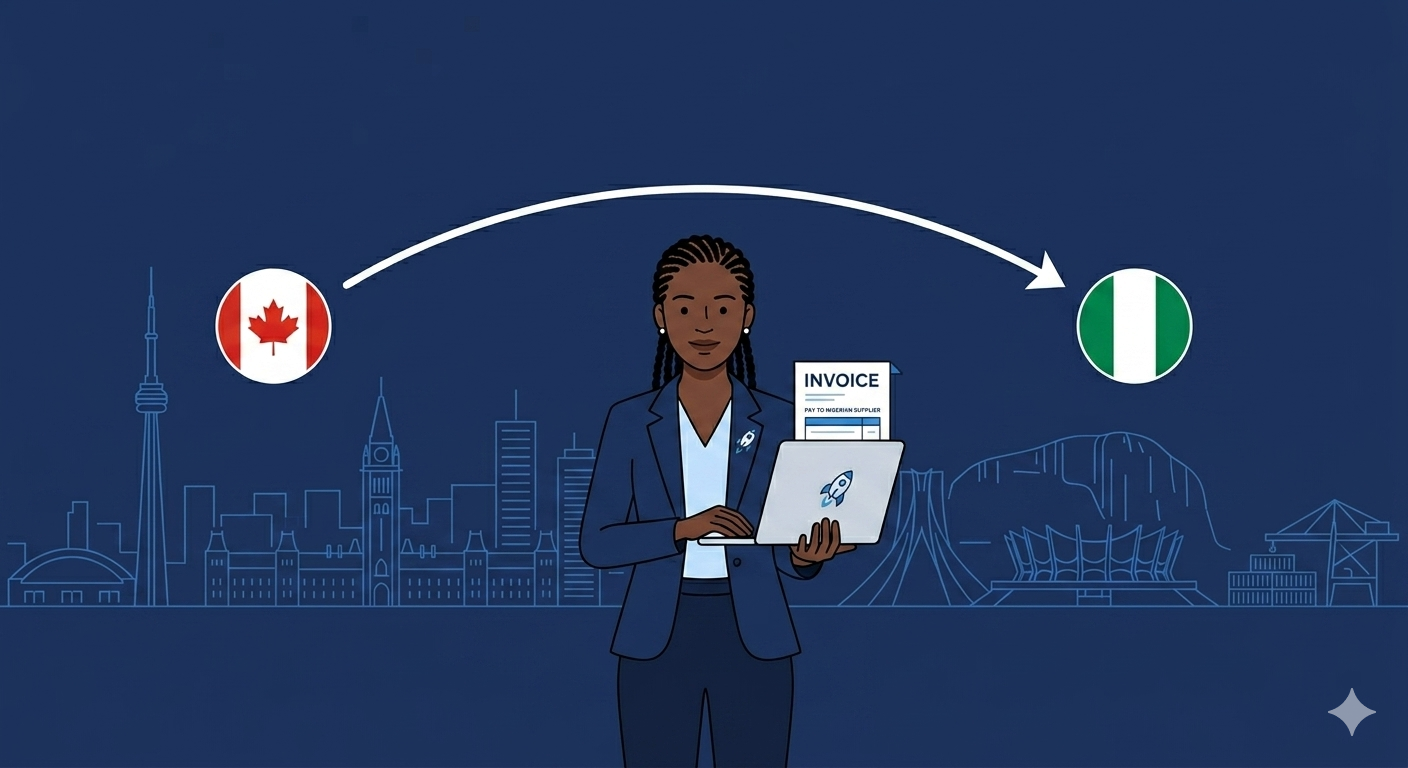
How to Pay Your Nigerian Supplier from Canada Without Getting Burned by the Exchange Rate

Read Time
read
TABLE OF CONTENT (we use H2, H3, H4)
Subscribe to the Afriex newsletter
Thank you! Your submission has been received!
Oops! Something went wrong while submitting the form.

The call came in early March. A Lagos-based fabric manufacturer, reliable supplier, fair prices. The Canadian buyer had sourced from them for three years. Then the wire hit. The Nigerian supplier came back confused: the naira amount landed 8% short of what they had agreed on.

No one stole anything. No fraud. Just a combination of a correspondent bank fee nobody mentioned, a spread buried in the "mid-market" rate that was not actually mid-market at all, and a three-day delay that meant the naira had moved by the time funds cleared. The CAD/NGN corridor quietly ate a chunk of the deal.

I have watched this happen to businesses across North America since we started building Afriex. The Canada-to-Nigeria payment corridor is one of the most underserved in the diaspora and B2B space. Search online for guidance and you will mostly find landing pages from Wise or Remitly optimized for family remittances, not for a Canadian business paying a garment supplier in Lagos or a tech services firm in Abuja. The practical, honest guide simply does not exist. This is my attempt to write it.

What the CAD to NGN Rate Actually Looks Like Right Now

As of mid-June 2026, the Nigerian naira sits at approximately 1,596 NGN per US dollar. On the CAD side, one Canadian dollar buys you roughly 1,160 to 1,180 naira depending on which channel you use and when you transact. Nigeria's foreign reserves are around $50 billion, and the Central Bank has been active in supporting the naira through its FX window. The official and parallel rates are closer than they have been in years.

That is actually good news if you are sending from Canada. The spread between what banks quote and what you actually pay is narrower than it was in 2023 or 2024, when naira volatility could swing 5-10% in a single week. Stability does not mean cheap, though. The cost question is about fees, rails, and timing. Not just the spot rate.

The World Bank estimated in its 2024 Remittance Prices Worldwide report that the global average cost to send $200 was 6.35%. On a $10,000 supplier payment, that is $635 out of pocket before your Nigerian supplier receives a single naira. And that is average. Some bank wire corridors run higher.

Why Traditional Bank Wires Punish This Corridor Specifically

A bank wire from Canada to Nigeria sounds simple. It is not. Canadian banks route international wires through correspondent banks in the US before they reach Nigerian banks, typically through major correspondent networks. Each bank in that chain can take a cut. Your Canadian bank charges an outbound wire fee, often $25-$50 CAD. The US correspondent may charge an intermediary fee, typically $15-$35 USD. The Nigerian receiving bank may deduct a landing fee on arrival. At each conversion step, the exchange rate applied carries a margin.

On a $5,000 CAD payment, you might lose $80-$120 in fees you can account for, plus another $60-$150 in exchange rate margin you never see itemized. Total cost: 3-5.5% of the transaction, gone before your supplier counts the naira.

The delay compounds everything. Standard SWIFT wires from Canada to Nigeria take 3-5 business days to clear. During that window, the CBN's FX rate can move. Your Nigerian supplier, if they are paying staff or raw material suppliers immediately, faces that timing risk on their end.

Nigerian businesses know this pain well. It is part of why stablecoin adoption for B2B payments has grown so sharply across the continent. Chainalysis data published this year shows stablecoins representing 43% of all crypto transaction volume in Sub-Saharan Africa, with the region receiving $205 billion in on-chain transactions in the 12 months to June 2025, up 52% year-on-year. Grey Business, one of the platforms serving African SMEs, processed $61.4 million in its first four months of operation, with USDC and USDT as the single largest payment channel. Nigerian businesses moved to stablecoins not for speculation, but because the cost and speed math made sense.

Three Realistic Options for Canadian Businesses Paying Nigerian Suppliers

When I map the realistic options for a Canadian business in this corridor, three paths come up that are actually worth your time.

The first is a dedicated digital transfer service. Platforms built specifically for diaspora and business corridors (rather than generic bank wires) typically offer better rates and lower fees by cutting out correspondent bank chains. The math on a $5,000 payment often comes out $100-$200 better than a standard wire, and delivery is typically 1-2 business days rather than 3-5. You are still transacting in CAD-to-NGN, so exchange rate timing matters. Lock in your rate when you confirm the transfer, not when the wire clears. We built Afriex to do exactly this kind of Canada-to-Nigeria transfer efficiently, though I would encourage you to compare options and find what fits your specific volume and cadence.

The second option is paying in USD rather than CAD. If your Nigerian supplier has a USD-denominated account, and many mid-sized businesses operating in Nigeria maintain USD accounts through their commercial bank, you can eliminate the CAD/NGN spread by paying in USD from a Canadian USD account and letting your supplier receive USD on their end. This does not eliminate fees, but it removes one conversion step and lets you negotiate your payment terms in a more stable currency. Your supplier can then hold or convert at their preferred timing. This is more common than it sounds. Ask your supplier directly whether they maintain a USD account. Many do, and they will appreciate the question.

The third option, increasingly common among B2B players in this corridor, is using a stablecoin rail for settlement. One party converts Canadian dollars to USDC, sends on-chain, and the Nigerian receiver converts to naira. Total fees: typically 0.3-1% plus whatever the naira off-ramp costs locally. Total time: minutes. The friction is mostly on the conversion and compliance side. Your business needs a Canadian crypto account with off-ramp to CAD, and your supplier needs a Nigerian platform that accepts USDC and converts to naira. Neither is trivial to set up, but for recurring high-value payments, the setup cost pays off quickly.

Most Guides Focus on the Platform. The Invoice Currency Is Where Businesses Actually Leave Money.

When you pay in CAD and your Nigerian supplier receives naira, one of you is absorbing the currency risk. The question is which, and whether either of you knows it.

If you wire CAD today and it takes four days to arrive as naira, the supplier received a naira amount based on the rate at settlement, not at agreement. If the naira strengthened between agreement and settlement, you paid more naira than you negotiated for. If it weakened, they received less. Both outcomes create friction in the relationship.

The professional move is to agree on a USD amount at deal signing, convert from CAD to USD on your end at the time of sending, and pay out USD. Both sides transact around the USD anchor, which is more predictable than either CAD or NGN in isolation. Your Canadian accountant will need to log the CAD/USD conversion, but your supplier receives a fixed dollar value and can plan their naira conversion on their own terms. This one structural change removes most of the post-payment confusion I described at the top of this piece.

What Nigeria's New Payment Roadmap Means for Cross-Border Senders

Last week, the CBN released Payment System Vision 2028. The document runs long, but one line cuts to what matters for businesses sending money into Nigeria: the Central Bank wants to position Nigeria as Africa's regional cross-border payments hub, with faster inbound rails and lower landing fees as explicit targets.

For practical purposes this means the Nigerian banking infrastructure for receiving international wires is improving, not declining. First-tier banks, Access, GTB, Zenith, First Bank, already handle inbound international transfers with reasonable predictability. Smaller commercial banks can still cause delays or apply non-standard conversion rates. It is worth asking your supplier which bank they use for international receipts. It is not rude to ask. It can save both of you days of confusion.

A Practical Checklist Before You Send

Confirm the supplier's exact account details: account name, bank name, SWIFT/BIC code, account number, and whether the account is NGN or USD-denominated. A mismatch between the name on the account and the beneficiary name you enter is the single most common reason Nigerian banks hold or return international wires.

Agree on the currency and the rate anchor before payment. USD is the simplest anchor. CAD-to-NGN leaves too much ambiguity.

Ask your transfer provider whether fees are charged from the sent amount or deducted by the receiving bank. "Receive full amount" options exist on most platforms but cost slightly more on your end. For B2B relationships where arriving short damages trust, the extra cost is usually worth it.

Keep your transaction receipt. CBN regulations require Nigerian banks to trace inbound foreign transfers, and if a wire is held for compliance review (more common for first-time transfers), your receipt with originating bank details speeds up resolution significantly.

Timing matters more than most people realize. Avoid sending on Fridays in either timezone. A wire leaving Toronto on Friday afternoon arrives at Lagos banks Monday or Tuesday at the earliest. CBN rate shifts over a weekend can move the naira amount meaningfully before your supplier receives anything.

The Real Cost of Not Sorting This Out

The businesses that lose money on Nigeria supplier payments are not the ones who got scammed. They are the ones who paid 4% in friction costs on every cycle and never noticed because they did not benchmark against anything. On $50,000 a year in supplier payments, that is $2,000 disappearing into wire fees and exchange rate margins. Think of it as a business class ticket from Toronto to Lagos, every year, paid to nobody in particular.

Most people leave this on the table because fixing your payment process feels like admin. It is not. It is relationship capital that shows up in your margins over time, and it determines whether your Nigerian supplier quotes you their best price or quietly builds in a buffer for payment risk on their end. Whether you are still explaining to your supplier why the wire landed short, or sending a clean payment they can count on, comes down to the same ten minutes of setup you have been putting off.

Subscribe to the Afriex newsletter
Thank you! Your submission has been received!
Oops! Something went wrong while submitting the form.
TABLE OF CONTENT
Subscribe to our newsletter
Read about our privacy policy.
Thank you! Your submission has been received!
Oops! Something went wrong while submitting the form.

The call came in early March. A Lagos-based fabric manufacturer, reliable supplier, fair prices. The Canadian buyer had sourced from them for three years. Then the wire hit. The Nigerian supplier came back confused: the naira amount landed 8% short of what they had agreed on.

No one stole anything. No fraud. Just a combination of a correspondent bank fee nobody mentioned, a spread buried in the "mid-market" rate that was not actually mid-market at all, and a three-day delay that meant the naira had moved by the time funds cleared. The CAD/NGN corridor quietly ate a chunk of the deal.

I have watched this happen to businesses across North America since we started building Afriex. The Canada-to-Nigeria payment corridor is one of the most underserved in the diaspora and B2B space. Search online for guidance and you will mostly find landing pages from Wise or Remitly optimized for family remittances, not for a Canadian business paying a garment supplier in Lagos or a tech services firm in Abuja. The practical, honest guide simply does not exist. This is my attempt to write it.

What the CAD to NGN Rate Actually Looks Like Right Now

As of mid-June 2026, the Nigerian naira sits at approximately 1,596 NGN per US dollar. On the CAD side, one Canadian dollar buys you roughly 1,160 to 1,180 naira depending on which channel you use and when you transact. Nigeria's foreign reserves are around $50 billion, and the Central Bank has been active in supporting the naira through its FX window. The official and parallel rates are closer than they have been in years.

That is actually good news if you are sending from Canada. The spread between what banks quote and what you actually pay is narrower than it was in 2023 or 2024, when naira volatility could swing 5-10% in a single week. Stability does not mean cheap, though. The cost question is about fees, rails, and timing. Not just the spot rate.

The World Bank estimated in its 2024 Remittance Prices Worldwide report that the global average cost to send $200 was 6.35%. On a $10,000 supplier payment, that is $635 out of pocket before your Nigerian supplier receives a single naira. And that is average. Some bank wire corridors run higher.

Why Traditional Bank Wires Punish This Corridor Specifically

A bank wire from Canada to Nigeria sounds simple. It is not. Canadian banks route international wires through correspondent banks in the US before they reach Nigerian banks, typically through major correspondent networks. Each bank in that chain can take a cut. Your Canadian bank charges an outbound wire fee, often $25-$50 CAD. The US correspondent may charge an intermediary fee, typically $15-$35 USD. The Nigerian receiving bank may deduct a landing fee on arrival. At each conversion step, the exchange rate applied carries a margin.

On a $5,000 CAD payment, you might lose $80-$120 in fees you can account for, plus another $60-$150 in exchange rate margin you never see itemized. Total cost: 3-5.5% of the transaction, gone before your supplier counts the naira.

The delay compounds everything. Standard SWIFT wires from Canada to Nigeria take 3-5 business days to clear. During that window, the CBN's FX rate can move. Your Nigerian supplier, if they are paying staff or raw material suppliers immediately, faces that timing risk on their end.

Nigerian businesses know this pain well. It is part of why stablecoin adoption for B2B payments has grown so sharply across the continent. Chainalysis data published this year shows stablecoins representing 43% of all crypto transaction volume in Sub-Saharan Africa, with the region receiving $205 billion in on-chain transactions in the 12 months to June 2025, up 52% year-on-year. Grey Business, one of the platforms serving African SMEs, processed $61.4 million in its first four months of operation, with USDC and USDT as the single largest payment channel. Nigerian businesses moved to stablecoins not for speculation, but because the cost and speed math made sense.

Three Realistic Options for Canadian Businesses Paying Nigerian Suppliers

When I map the realistic options for a Canadian business in this corridor, three paths come up that are actually worth your time.

The first is a dedicated digital transfer service. Platforms built specifically for diaspora and business corridors (rather than generic bank wires) typically offer better rates and lower fees by cutting out correspondent bank chains. The math on a $5,000 payment often comes out $100-$200 better than a standard wire, and delivery is typically 1-2 business days rather than 3-5. You are still transacting in CAD-to-NGN, so exchange rate timing matters. Lock in your rate when you confirm the transfer, not when the wire clears. We built Afriex to do exactly this kind of Canada-to-Nigeria transfer efficiently, though I would encourage you to compare options and find what fits your specific volume and cadence.

The second option is paying in USD rather than CAD. If your Nigerian supplier has a USD-denominated account, and many mid-sized businesses operating in Nigeria maintain USD accounts through their commercial bank, you can eliminate the CAD/NGN spread by paying in USD from a Canadian USD account and letting your supplier receive USD on their end. This does not eliminate fees, but it removes one conversion step and lets you negotiate your payment terms in a more stable currency. Your supplier can then hold or convert at their preferred timing. This is more common than it sounds. Ask your supplier directly whether they maintain a USD account. Many do, and they will appreciate the question.

The third option, increasingly common among B2B players in this corridor, is using a stablecoin rail for settlement. One party converts Canadian dollars to USDC, sends on-chain, and the Nigerian receiver converts to naira. Total fees: typically 0.3-1% plus whatever the naira off-ramp costs locally. Total time: minutes. The friction is mostly on the conversion and compliance side. Your business needs a Canadian crypto account with off-ramp to CAD, and your supplier needs a Nigerian platform that accepts USDC and converts to naira. Neither is trivial to set up, but for recurring high-value payments, the setup cost pays off quickly.

Most Guides Focus on the Platform. The Invoice Currency Is Where Businesses Actually Leave Money.

When you pay in CAD and your Nigerian supplier receives naira, one of you is absorbing the currency risk. The question is which, and whether either of you knows it.

If you wire CAD today and it takes four days to arrive as naira, the supplier received a naira amount based on the rate at settlement, not at agreement. If the naira strengthened between agreement and settlement, you paid more naira than you negotiated for. If it weakened, they received less. Both outcomes create friction in the relationship.

The professional move is to agree on a USD amount at deal signing, convert from CAD to USD on your end at the time of sending, and pay out USD. Both sides transact around the USD anchor, which is more predictable than either CAD or NGN in isolation. Your Canadian accountant will need to log the CAD/USD conversion, but your supplier receives a fixed dollar value and can plan their naira conversion on their own terms. This one structural change removes most of the post-payment confusion I described at the top of this piece.

What Nigeria's New Payment Roadmap Means for Cross-Border Senders

Last week, the CBN released Payment System Vision 2028. The document runs long, but one line cuts to what matters for businesses sending money into Nigeria: the Central Bank wants to position Nigeria as Africa's regional cross-border payments hub, with faster inbound rails and lower landing fees as explicit targets.

For practical purposes this means the Nigerian banking infrastructure for receiving international wires is improving, not declining. First-tier banks, Access, GTB, Zenith, First Bank, already handle inbound international transfers with reasonable predictability. Smaller commercial banks can still cause delays or apply non-standard conversion rates. It is worth asking your supplier which bank they use for international receipts. It is not rude to ask. It can save both of you days of confusion.

A Practical Checklist Before You Send

Confirm the supplier's exact account details: account name, bank name, SWIFT/BIC code, account number, and whether the account is NGN or USD-denominated. A mismatch between the name on the account and the beneficiary name you enter is the single most common reason Nigerian banks hold or return international wires.

Agree on the currency and the rate anchor before payment. USD is the simplest anchor. CAD-to-NGN leaves too much ambiguity.

Ask your transfer provider whether fees are charged from the sent amount or deducted by the receiving bank. "Receive full amount" options exist on most platforms but cost slightly more on your end. For B2B relationships where arriving short damages trust, the extra cost is usually worth it.

Keep your transaction receipt. CBN regulations require Nigerian banks to trace inbound foreign transfers, and if a wire is held for compliance review (more common for first-time transfers), your receipt with originating bank details speeds up resolution significantly.

Timing matters more than most people realize. Avoid sending on Fridays in either timezone. A wire leaving Toronto on Friday afternoon arrives at Lagos banks Monday or Tuesday at the earliest. CBN rate shifts over a weekend can move the naira amount meaningfully before your supplier receives anything.

The Real Cost of Not Sorting This Out

The businesses that lose money on Nigeria supplier payments are not the ones who got scammed. They are the ones who paid 4% in friction costs on every cycle and never noticed because they did not benchmark against anything. On $50,000 a year in supplier payments, that is $2,000 disappearing into wire fees and exchange rate margins. Think of it as a business class ticket from Toronto to Lagos, every year, paid to nobody in particular.

Most people leave this on the table because fixing your payment process feels like admin. It is not. It is relationship capital that shows up in your margins over time, and it determines whether your Nigerian supplier quotes you their best price or quietly builds in a buffer for payment risk on their end. Whether you are still explaining to your supplier why the wire landed short, or sending a clean payment they can count on, comes down to the same ten minutes of setup you have been putting off.

Text Link

Lorem ipsum dolor sit amet, consectetur adipiscing elit. Suspendisse varius enim in eros elementum tristique. Duis cursus, mi quis viverra ornare, eros dolor interdum nulla, ut commodo diam libero vitae erat. Aenean faucibus nibh et justo cursus id rutrum lorem imperdiet. Nunc ut sem vitae risus tristique posuere.

The call came in early March. A Lagos-based fabric manufacturer, reliable supplier, fair prices. The Canadian buyer had sourced from them for three years. Then the wire hit. The Nigerian supplier came back confused: the naira amount landed 8% short of what they had agreed on.

No one stole anything. No fraud. Just a combination of a correspondent bank fee nobody mentioned, a spread buried in the "mid-market" rate that was not actually mid-market at all, and a three-day delay that meant the naira had moved by the time funds cleared. The CAD/NGN corridor quietly ate a chunk of the deal.

I have watched this happen to businesses across North America since we started building Afriex. The Canada-to-Nigeria payment corridor is one of the most underserved in the diaspora and B2B space. Search online for guidance and you will mostly find landing pages from Wise or Remitly optimized for family remittances, not for a Canadian business paying a garment supplier in Lagos or a tech services firm in Abuja. The practical, honest guide simply does not exist. This is my attempt to write it.

What the CAD to NGN Rate Actually Looks Like Right Now

As of mid-June 2026, the Nigerian naira sits at approximately 1,596 NGN per US dollar. On the CAD side, one Canadian dollar buys you roughly 1,160 to 1,180 naira depending on which channel you use and when you transact. Nigeria's foreign reserves are around $50 billion, and the Central Bank has been active in supporting the naira through its FX window. The official and parallel rates are closer than they have been in years.

That is actually good news if you are sending from Canada. The spread between what banks quote and what you actually pay is narrower than it was in 2023 or 2024, when naira volatility could swing 5-10% in a single week. Stability does not mean cheap, though. The cost question is about fees, rails, and timing. Not just the spot rate.

The World Bank estimated in its 2024 Remittance Prices Worldwide report that the global average cost to send $200 was 6.35%. On a $10,000 supplier payment, that is $635 out of pocket before your Nigerian supplier receives a single naira. And that is average. Some bank wire corridors run higher.

Why Traditional Bank Wires Punish This Corridor Specifically

A bank wire from Canada to Nigeria sounds simple. It is not. Canadian banks route international wires through correspondent banks in the US before they reach Nigerian banks, typically through major correspondent networks. Each bank in that chain can take a cut. Your Canadian bank charges an outbound wire fee, often $25-$50 CAD. The US correspondent may charge an intermediary fee, typically $15-$35 USD. The Nigerian receiving bank may deduct a landing fee on arrival. At each conversion step, the exchange rate applied carries a margin.

On a $5,000 CAD payment, you might lose $80-$120 in fees you can account for, plus another $60-$150 in exchange rate margin you never see itemized. Total cost: 3-5.5% of the transaction, gone before your supplier counts the naira.

The delay compounds everything. Standard SWIFT wires from Canada to Nigeria take 3-5 business days to clear. During that window, the CBN's FX rate can move. Your Nigerian supplier, if they are paying staff or raw material suppliers immediately, faces that timing risk on their end.

Nigerian businesses know this pain well. It is part of why stablecoin adoption for B2B payments has grown so sharply across the continent. Chainalysis data published this year shows stablecoins representing 43% of all crypto transaction volume in Sub-Saharan Africa, with the region receiving $205 billion in on-chain transactions in the 12 months to June 2025, up 52% year-on-year. Grey Business, one of the platforms serving African SMEs, processed $61.4 million in its first four months of operation, with USDC and USDT as the single largest payment channel. Nigerian businesses moved to stablecoins not for speculation, but because the cost and speed math made sense.

Three Realistic Options for Canadian Businesses Paying Nigerian Suppliers

When I map the realistic options for a Canadian business in this corridor, three paths come up that are actually worth your time.

The first is a dedicated digital transfer service. Platforms built specifically for diaspora and business corridors (rather than generic bank wires) typically offer better rates and lower fees by cutting out correspondent bank chains. The math on a $5,000 payment often comes out $100-$200 better than a standard wire, and delivery is typically 1-2 business days rather than 3-5. You are still transacting in CAD-to-NGN, so exchange rate timing matters. Lock in your rate when you confirm the transfer, not when the wire clears. We built Afriex to do exactly this kind of Canada-to-Nigeria transfer efficiently, though I would encourage you to compare options and find what fits your specific volume and cadence.

The second option is paying in USD rather than CAD. If your Nigerian supplier has a USD-denominated account, and many mid-sized businesses operating in Nigeria maintain USD accounts through their commercial bank, you can eliminate the CAD/NGN spread by paying in USD from a Canadian USD account and letting your supplier receive USD on their end. This does not eliminate fees, but it removes one conversion step and lets you negotiate your payment terms in a more stable currency. Your supplier can then hold or convert at their preferred timing. This is more common than it sounds. Ask your supplier directly whether they maintain a USD account. Many do, and they will appreciate the question.

The third option, increasingly common among B2B players in this corridor, is using a stablecoin rail for settlement. One party converts Canadian dollars to USDC, sends on-chain, and the Nigerian receiver converts to naira. Total fees: typically 0.3-1% plus whatever the naira off-ramp costs locally. Total time: minutes. The friction is mostly on the conversion and compliance side. Your business needs a Canadian crypto account with off-ramp to CAD, and your supplier needs a Nigerian platform that accepts USDC and converts to naira. Neither is trivial to set up, but for recurring high-value payments, the setup cost pays off quickly.

Most Guides Focus on the Platform. The Invoice Currency Is Where Businesses Actually Leave Money.

When you pay in CAD and your Nigerian supplier receives naira, one of you is absorbing the currency risk. The question is which, and whether either of you knows it.

If you wire CAD today and it takes four days to arrive as naira, the supplier received a naira amount based on the rate at settlement, not at agreement. If the naira strengthened between agreement and settlement, you paid more naira than you negotiated for. If it weakened, they received less. Both outcomes create friction in the relationship.

The professional move is to agree on a USD amount at deal signing, convert from CAD to USD on your end at the time of sending, and pay out USD. Both sides transact around the USD anchor, which is more predictable than either CAD or NGN in isolation. Your Canadian accountant will need to log the CAD/USD conversion, but your supplier receives a fixed dollar value and can plan their naira conversion on their own terms. This one structural change removes most of the post-payment confusion I described at the top of this piece.

What Nigeria's New Payment Roadmap Means for Cross-Border Senders

Last week, the CBN released Payment System Vision 2028. The document runs long, but one line cuts to what matters for businesses sending money into Nigeria: the Central Bank wants to position Nigeria as Africa's regional cross-border payments hub, with faster inbound rails and lower landing fees as explicit targets.

For practical purposes this means the Nigerian banking infrastructure for receiving international wires is improving, not declining. First-tier banks, Access, GTB, Zenith, First Bank, already handle inbound international transfers with reasonable predictability. Smaller commercial banks can still cause delays or apply non-standard conversion rates. It is worth asking your supplier which bank they use for international receipts. It is not rude to ask. It can save both of you days of confusion.

A Practical Checklist Before You Send

Confirm the supplier's exact account details: account name, bank name, SWIFT/BIC code, account number, and whether the account is NGN or USD-denominated. A mismatch between the name on the account and the beneficiary name you enter is the single most common reason Nigerian banks hold or return international wires.

Agree on the currency and the rate anchor before payment. USD is the simplest anchor. CAD-to-NGN leaves too much ambiguity.

Ask your transfer provider whether fees are charged from the sent amount or deducted by the receiving bank. "Receive full amount" options exist on most platforms but cost slightly more on your end. For B2B relationships where arriving short damages trust, the extra cost is usually worth it.

Keep your transaction receipt. CBN regulations require Nigerian banks to trace inbound foreign transfers, and if a wire is held for compliance review (more common for first-time transfers), your receipt with originating bank details speeds up resolution significantly.

Timing matters more than most people realize. Avoid sending on Fridays in either timezone. A wire leaving Toronto on Friday afternoon arrives at Lagos banks Monday or Tuesday at the earliest. CBN rate shifts over a weekend can move the naira amount meaningfully before your supplier receives anything.

The Real Cost of Not Sorting This Out

The businesses that lose money on Nigeria supplier payments are not the ones who got scammed. They are the ones who paid 4% in friction costs on every cycle and never noticed because they did not benchmark against anything. On $50,000 a year in supplier payments, that is $2,000 disappearing into wire fees and exchange rate margins. Think of it as a business class ticket from Toronto to Lagos, every year, paid to nobody in particular.

Most people leave this on the table because fixing your payment process feels like admin. It is not. It is relationship capital that shows up in your margins over time, and it determines whether your Nigerian supplier quotes you their best price or quietly builds in a buffer for payment risk on their end. Whether you are still explaining to your supplier why the wire landed short, or sending a clean payment they can count on, comes down to the same ten minutes of setup you have been putting off.

Related Articles

No items found.

Heading 1

Heading 2

Heading 3

Heading 4

Heading 5
Heading 6

Lorem ipsum dolor sit amet, consectetur adipiscing elit, sed do eiusmod tempor incididunt ut labore et dolore magna aliqua. Ut enim ad minim veniam, quis nostrud exercitation ullamco laboris nisi ut aliquip ex ea commodo consequat. Duis aute irure dolor in reprehenderit in voluptate velit esse cillum dolore eu fugiat nulla pariatur.

Block quote

Ordered list

  1. Item 1
  2. Item 2
  3. Item 3

Unordered list

Text link

Bold text

Emphasis

Superscript

Subscript