

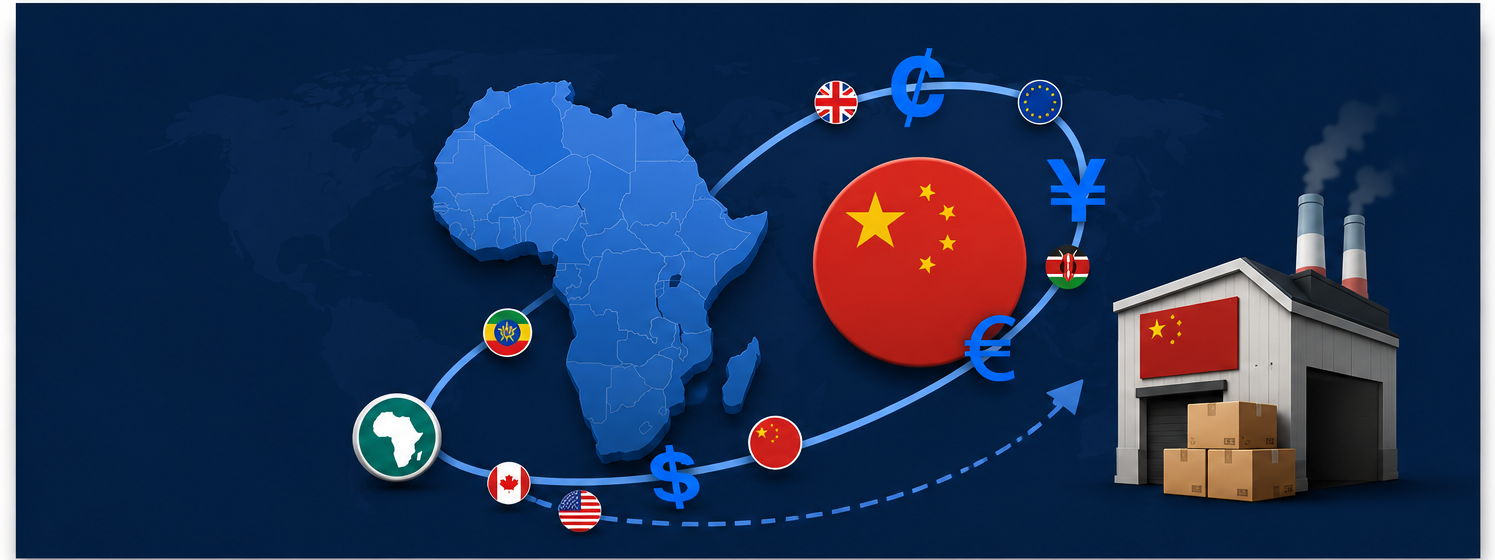

I got a message a few months ago from an importer in Lagos who sources electronics from Guangzhou. He'd been wire-transferring money to his supplier for three years through a local bank. His most recent transfer sat in compliance review for eleven days while his supplier threatened to sell the consignment to someone else. "I've already paid," he told me. "I just can't actually get the money there."
That story isn't unusual. Across West and East Africa, I keep hearing versions of the same thing. A manufacturer in Accra waiting a week for dollar payments to clear. A clothing trader in Nairobi who lost a supplier relationship because a transfer failed three times in a row. Cross-border business payments in Africa, particularly for the China corridor, have been broken in ways that feel almost normalized by now. And for a long time, most businesses absorbed the cost because there wasn't a widely understood alternative.
What's changed is that businesses are no longer just complaining. They're routing around the problem, and the numbers are starting to show it.
The Quiet Shift Happening in African Trade Right Now
A TechCabal investigation published this week found that importers in Lagos, Accra, and Nairobi are increasingly settling invoices with Chinese suppliers in USDT, the dollar-pegged stablecoin, rather than bank wire transfers. The numbers are striking. Businesses that used to pay 3% to 5% in fees and wait five to seven business days are now sending money in minutes for under a dollar in transaction costs. Some freight forwarding companies have started formally listing USDT as an accepted payment method, not as a workaround but as a standard option on their invoices.
This is not a niche crypto story. This is trade finance adapting in real time because the existing infrastructure keeps failing the people depending on it.
Sub-Saharan Africa processed a record $50 billion in stablecoin transactions in the first quarter of 2026, a 340% year-over-year increase according to Chainalysis data. Nigeria, Ghana, and Kenya are among the world's fastest-growing stablecoin markets. A significant portion of that volume is business-to-business, not retail speculation. When those numbers sit alongside the fact that the China-Africa trade corridor moves hundreds of billions in goods every year, the scale of what's shifting becomes real.
Why Bank Transfers Keep Failing African Importers
To understand why businesses are making this shift, you have to sit with how painful the traditional process actually is.
A Nigerian importer using a commercial bank to send dollars to China faces a chain of friction points. First, there's the Form M process, the CBN's official mechanism for accessing forex for imports. It requires documentation and approval, and often takes days just to initiate. Then the transfer enters correspondent banking networks where African banks have limited relationships, meaning the money bounces through multiple intermediaries before reaching its destination. Each hop adds fees, delays, and potential rejection points.
Compliance scrutiny has intensified in recent years. US and European correspondent banks have been de-risking their Africa exposures, dropping relationships with local banks they consider high-risk, which leaves fewer routing options and more delays for everyone. For a business importing $20,000 worth of goods on tight margins, a 3% transfer fee plus a week of uncertainty isn't just inconvenient. It affects your cash flow, your supplier relationships, and sometimes the viability of the deal itself.
The CBN introduced a new forex directive in late May requiring exporters to repatriate earnings within 90 days rather than 180, while tightening documentation requirements for importers at the same time. For businesses operating on standard payment terms where buyers take 90 to 120 days to settle, this creates a genuinely difficult position. You're expected to comply with regulations designed around a system that doesn't actually work reliably.
The World Bank has consistently flagged Africa as having the most expensive remittance and payment corridors in the world. For the average Nigerian importer, the cost and complexity of sending money to China is not a random inconvenience. It's a structural tax on doing business that doesn't apply the same way to competitors in other markets.
What Most Businesses Get Wrong About Stablecoin Payments
When I talk to business owners who are considering stablecoins for supplier payments, the conversation usually gets stuck in two places. Either they assume it's purely a crypto risk they want to avoid, or they dive in without thinking through the operational setup.
The risk question is real but often miscalibrated. USDT is pegged to the dollar. The volatility risk that most people associate with crypto is not the same exposure here. Holding USDT overnight to make a payment is not the same as holding Bitcoin or any other asset that can move 20% in a day. For a business essentially trying to move value from point A to point B in dollars, a dollar-pegged stablecoin does exactly that.
The real risks are different ones, and most people skip past them. The first is counterparty risk on the exchange side. Where are you sourcing USDT, and through what platform? Peer-to-peer exchanges in Nigeria operate with varying degrees of reliability and compliance, and buying through the wrong platform creates exposure that the average business owner hasn't fully priced in. The second is regulatory uncertainty. USDT payments for trade are operating in a grey area in Nigeria and Ghana right now. The CBN has acknowledged the practice is growing, and Africa's stablecoin regulation conversation is accelerating, but formal frameworks are still being developed. You want to understand your exposure before building a critical process around a channel that could shift.
The operational piece most businesses miss is the workflow. A wire transfer, for all its faults, slots into existing finance department procedures. Invoices, approvals, bank records. USDT transactions require someone in your business to manage wallet custody, understand blockchain confirmations, and keep documentation that holds up under audit. That's manageable, but it's not nothing, and businesses that treat it as a casual workaround rather than a finance process tend to run into problems.
What's Actually Working Right Now
For businesses that have made this shift successfully, a few patterns come up consistently.
They use regulated platforms or established fintech rails rather than pure peer-to-peer. There are now several companies operating in Nigeria, Ghana, and Kenya specifically designed to help businesses move money internationally using stablecoin infrastructure on the back end, while presenting a more familiar interface on the front. You're not necessarily holding USDT yourself. You're using a service that handles the conversion and routing with compliance built in. That distinction matters considerably from both a risk and a process standpoint.
They have explicit supplier agreement upfront. This sounds obvious, but it trips people up. Your supplier in China needs a wallet address and needs to be comfortable receiving USDT. Many Chinese suppliers, particularly in manufacturing hubs like Guangzhou and Yiwu, now have this setup because enough African buyers have asked for it. But you want to confirm before you build this into your payment process, not discover the gap when a shipment is already in transit.
They keep documentation as rigorous as they would for any bank transfer. The fact that the transaction moves faster doesn't mean the paper trail should be lighter. Invoice, confirmation of receipt, wallet addresses on both sides, amount, date, any exchange rate used if converting from naira. Keep the same records you'd want if you were audited on a SWIFT transfer, because the documentation standard applies regardless of the rails you used.
They don't move their entire payment volume immediately. Businesses that have done this well tend to pilot with a smaller transaction first, confirm the full cycle works including the supplier's confirmation that funds are received, and then expand from there. Running your entire import financing through a new channel without testing the workflow is unnecessary risk.
How to Think About the Decision
If you're importing from China or another major corridor and you're still routing everything through correspondent banking because it's familiar, the gap in cost and speed between that and the alternatives is now large enough that it's worth a direct comparison rather than an assumption.
I'd encourage you to look at what platforms are operating in your specific market, understand their compliance posture, and pilot a smaller payment before restructuring your whole workflow. We built Afriex to help African businesses move money internationally with less friction, and it's one option worth considering, though I'll always encourage you to compare and find what actually fits your corridors and suppliers.
The more important shift is in how you think about the problem. Payment infrastructure was treated for years as a fixed cost. The businesses moving faster now are the ones who started treating it as solvable.
The Practical Question to Answer This Week
The China-Africa trade corridor alone processes hundreds of billions in goods annually. The $50 billion in stablecoin volume recorded in Q1 2026 is still a fraction of that, but the direction is clear. African businesses are not waiting for traditional banking infrastructure to catch up. They're finding routes that actually work.
If your payment process is still costing you 3% on every international transaction and making you wait a week for confirmation, that's not just a financial cost. It's the supplier trust burning when transfers are delayed. It's the deals you can't close because your cash flow is uncertain. It's the competitive disadvantage relative to importers who have already figured out faster rails.
Find out what you're actually paying per international transfer, fees plus the cost of delays, from the moment you initiate to the moment your supplier confirms receipt. Then compare that to what's available in 2026. The answer will probably push you to move faster than you planned.


.svg)
.svg)
.svg)
.svg)
.svg)
.svg)
.svg)
.svg)
.svg)
.svg)
.svg)
.svg)
.svg)
.svg)
.svg)
.svg)
.svg)
.svg)
.svg)
.svg)
.svg)
.svg)
.svg)
.svg)
.svg)
.svg)
.svg)
.svg)
.svg)
.svg)
.svg)
.svg)
.svg)
.svg)
.svg)
.svg)
.svg)
.svg)
.svg)
.svg)
.svg)
.svg)
.svg)
.svg)
.svg)
.svg)


.png)

.png)