

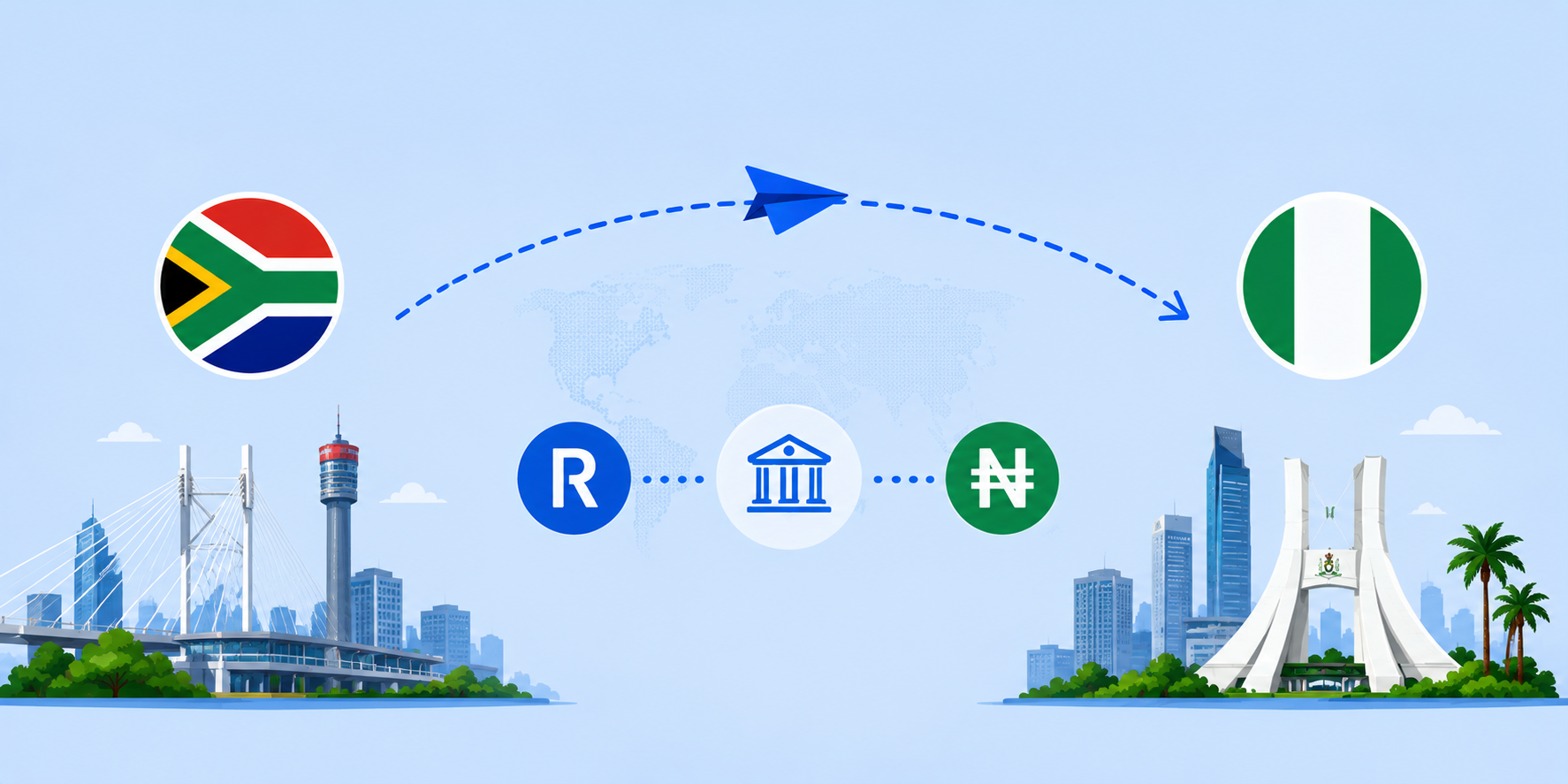

South Africa has one of the largest Nigerian diaspora populations on the continent. Hundreds of thousands of Nigerians live and work in Johannesburg, Cape Town, and Durban, and every month a significant portion of them need to get money home. When rent is due in Lagos, when school fees are past due in Ibadan, when a parent falls sick in Kano, the transfer cannot wait.
What they usually find is that this should be easier than it is.
The ZAR-to-NGN corridor carries real volume, real urgency, and real financial stakes. I have talked to enough people navigating it to know that the frustration is structural, not accidental. Most transfer services were built around the dollar-to-Africa flow. They treat the South Africa to Nigeria route as a secondary case, and the pricing and product quality often reflect that.
I want to walk through what this corridor actually looks like right now: what the costs are, what the options are, what you need to have ready, and where people routinely get it wrong.
Why This Route Is Harder Than It Looks
On paper, South Africa and Nigeria are the two largest economies in Africa. They share significant trade, a connected diaspora, and growing business ties. On paper, moving money between them should be straightforward.
In practice, the ZAR-to-NGN exchange rate route often forces a detour through the US dollar. Services that do not directly support the rand-to-naira pair will convert your rand into dollars first, then convert those dollars into naira. Each conversion carries a spread, meaning you pay twice for the exchange rate friction before the money arrives. If the service isn't transparent about this, you might only notice when you see the final naira figure and realise it's lower than expected.
The rand has faced sustained pressure over the last two years, losing value against major reserve currencies even as South Africa's Reserve Bank held rates at elevated levels to manage inflation. The naira, for its part, found a new floor after CBN reforms in 2023 and 2024, but continues to move with enough volatility that the rate you check on Monday might look quite different from the rate that processes on Wednesday. Anyone sending money on this route regularly is navigating two currencies under pressure. That context matters when you think about the right service and the right time to send.
The Real Cost Calculation
Most people focus on the transfer fee. That is the wrong number to focus on first.
My habit, before confirming any transfer, is to check the mid-market exchange rate (what you see when you type "ZAR to NGN" into Google) and then compare that to the rate the service is actually offering. The difference between those two numbers is the exchange rate margin, and it is almost always larger than the flat transfer fee.
A service advertising zero transfer fees but using an exchange rate that's 4 percent below mid-market will cost you more on a R10,000 transfer than a service charging a flat R150 fee with a tighter rate. The math takes thirty seconds to run, and it changes which option looks best for your specific transfer amount. Do it every time.
When you factor in both the rate margin and any flat fees, you get the true cost of the transfer. That number, expressed as a percentage of the amount sent, is the only honest way to compare services across different pricing structures.
What the Options Actually Look Like
When I look at what is genuinely available on the South Africa to Nigeria route today, the picture is better than it was two or three years ago, but it still requires care.
Digital-first transfer platforms designed for African corridors are the strongest option for most people. Services like Afriex are built specifically for intra-African flows, including the South Africa to Nigeria route, rather than being dollar-centric platforms that added African corridors as an afterthought. I built Afriex with exactly this kind of gap in mind, though I would genuinely encourage you to compare what is available and pick what fits your transfer frequency and amounts. The key signal is whether the platform handles ZAR natively or routes through a third currency.
Traditional bank wires work but rarely make sense below R50,000. If you have a private banking relationship in South Africa and you are sending large amounts regularly, some banks offer negotiated FX rates for substantial transfers. Below that level, the combination of fixed international wire fees (often R200 to R400 per transaction) and non-competitive exchange rate margins makes a digital platform a clearly better value.
Mobile money is expanding rapidly across Africa but the South Africa to Nigeria corridor does not yet have the direct mobile-money-to-mobile-money infrastructure that exists on some East African routes. The Kenya to Uganda flow via M-Pesa, for example, has no equivalent here. Transfers to Nigeria still primarily land in a bank account, not a mobile wallet. That may change as mobile banking infrastructure deepens on both sides, but for now, budget for a bank account on the receiving end.
For Businesses Sending on This Route
If you are a South African business with Nigerian suppliers, or a Nigerian business with a South African operation, the cost dynamics shift in a few ways worth understanding.
First, volume matters. If you are making regular transfers above R50,000, negotiating directly with a transfer provider often yields better rates than using a consumer product. Some platforms offer business accounts with lower spreads for regular high-volume transfers.
Second, documentation requirements become more significant. Business transfers from South Africa require proof of the underlying transaction: an invoice, a contract, or a services agreement. This is not bureaucratic noise. It is a legal requirement under South African exchange control regulations. Budget for this documentation step and build it into your payment process from the start, not as an afterthought when a transfer is held up.
Third, consider the naira receipt structure on the Nigerian side. If your Nigerian counterpart has a domiciliary account, some services allow the transfer to arrive in dollars, which the recipient can hold or convert at a time of their choosing. This can be valuable when the naira is moving and the recipient wants to manage their own conversion timing.
What You Need Before You Start
The South Africa side requires your South African ID or passport, your address as registered with your bank, and your South African bank account or card to fund the transfer. Services operating in South Africa fall under the oversight of the Financial Sector Conduct Authority and the South African Reserve Bank. Any legitimate service will ask you to verify your identity before processing, especially for amounts above R25,000.
On the Nigerian receiving side, you need the full beneficiary name exactly as it appears on their bank account, the 10-digit NUBAN account number (every Nigerian bank account has this), and the bank name. Some services also ask for the recipient's phone number. Getting these details wrong, especially the account name, is the most common cause of transfer delays.
The Regulatory Limit You Need to Know
South Africa allows individuals to transfer money abroad under what is called the single discretionary allowance. This currently permits up to R1 million per calendar year without requiring additional tax clearance from SARS. Above that, you need a tax clearance certificate, and legitimate transfer services will flag this threshold and ask for supporting documentation.
This is not a ceiling designed to inconvenience ordinary senders. Most people sending remittances or paying suppliers will never approach it. But if you are a Nigerian professional in South Africa managing family finances back home alongside business payments, it is worth tracking your transfers across the year rather than discovering you have hit the limit mid-year when you need to make an urgent transfer.
On the Nigerian side, the CBN requires inbound international transfers to arrive in the beneficiary's name. Third-party receipts have become more restricted in recent years as Nigeria tightened AML compliance. The funds will typically arrive in naira at the prevailing CBN or bank rate, unless the recipient is receiving into a domiciliary account in which case they receive dollars.
Building the Habit
The South Africa to Nigeria route is not going to surprise you with hidden complexity once you understand how it works. The ZAR-to-NGN pair requires paying attention to the exchange rate, not just the fee. The documentation on both sides requires preparation rather than improvisation. The regulatory framework is knowable.
I have seen people absorb years of unnecessary costs on this corridor simply because they picked the first option they found and never checked whether it was competitive. The difference between a well-chosen transfer service and a poorly chosen one on regular transfers can add up to thousands of rand over a year, and those are rand that should arrive as naira in someone's account, not disappear into rate margins.
Compare the rates. Check the mid-market rate first. Get the recipient details right before you start. And build a rhythm around the transfer so it becomes a managed process rather than a stressful scramble each time.




.svg)
.svg)
.svg)
.svg)
.svg)
.svg)
.svg)
.svg)
.svg)
.svg)
.svg)
.svg)
.svg)
.svg)
.svg)
.svg)
.svg)
.svg)
.svg)
.svg)
.svg)
.svg)
.svg)
.svg)
.svg)
.svg)
.svg)
.svg)
.svg)
.svg)
.svg)
.svg)
.svg)
.svg)
.svg)
.svg)
.svg)
.svg)
.svg)
.svg)
.svg)
.svg)
.svg)
.svg)
.svg)
.svg)


.png)

.png)