


The shipment was sitting in a warehouse in Guangzhou. The supplier had sent three follow-up messages in two days. And my friend, a clothing importer who has been doing this for six years, still could not get his bank to process the wire transfer.
He wasn't a first-time importer who didn't read the fine print. He knew the system, had his documents ready, planned the timing carefully, and still watched his shipment sit for three weeks because the Ghana-to-China payment corridor is genuinely difficult. The bank eventually flagged his transaction for additional review. By the time it cleared, he had missed the container he'd booked.
I have heard versions of this story more times than I can count. Ghanaian importers are among the most active buyers on Alibaba. The Canton Fair draws thousands of buyers from Accra every season. China is Ghana's largest source of imports, accounting for roughly 20 percent of everything that enters the country. And yet the payment infrastructure for this corridor is still punishing for most small and medium-sized businesses.
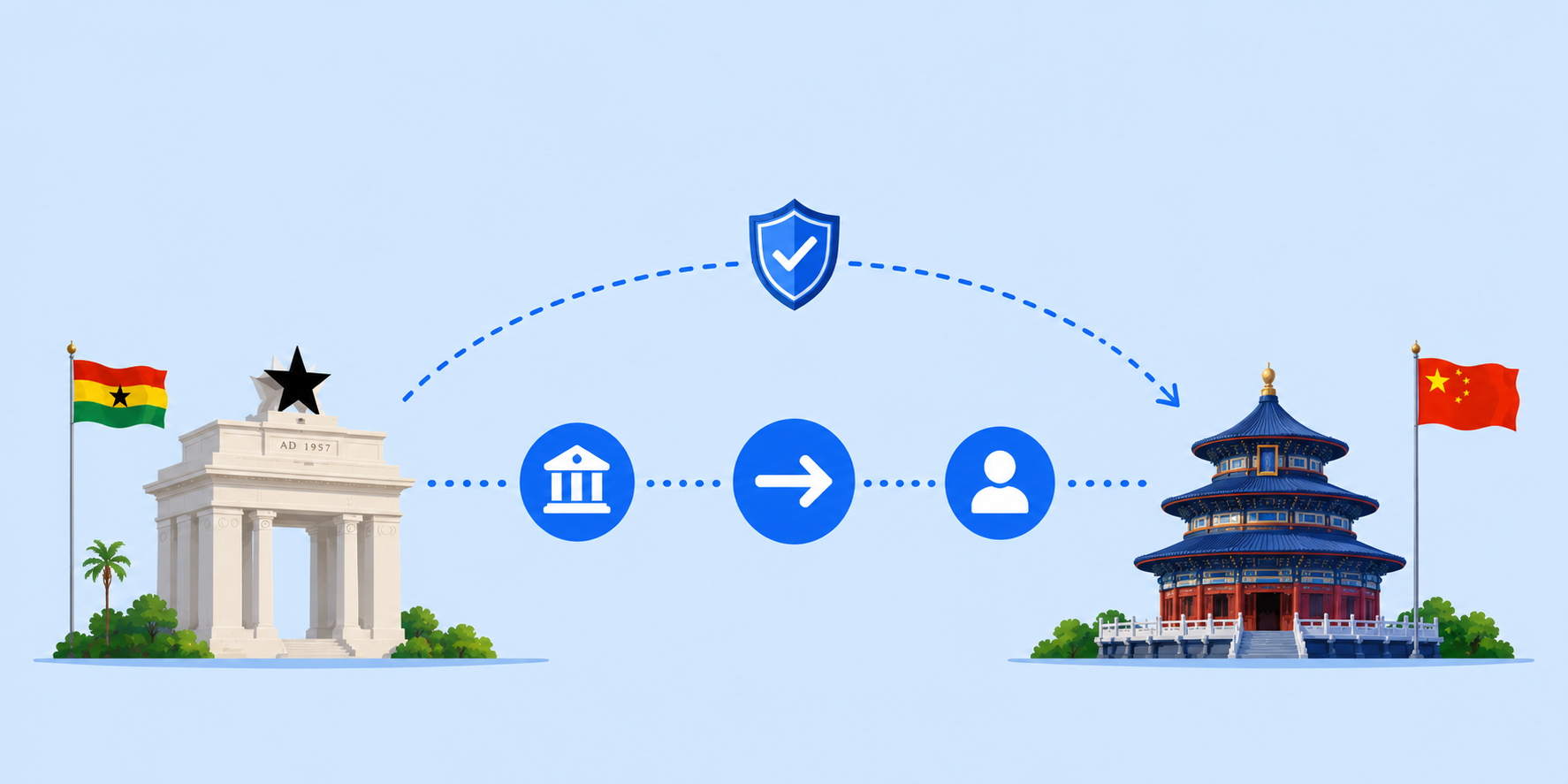
If you're reading this because you need to pay a supplier in China and your bank just told you to come back with more paperwork, I want to walk you through what's actually available.
Why Sending Money from Ghana to China Is Harder Than It Looks
The short answer is currency. The Ghanaian cedi has depreciated significantly against both the US dollar and the Chinese yuan over the past few years. Ghana's currency dropped more than 30 percent against the dollar in 2022 alone, and while things have stabilised somewhat, the cedi remains under pressure. When you're buying from a Chinese supplier and pricing your goods in dollars or yuan, every movement in the exchange rate eats into your margin.
But the currency story is only part of it. Ghana's foreign exchange regulations mean that commercial banks apply scrutiny to outbound international transfers, particularly for amounts above certain thresholds. You'll need to demonstrate the trade purpose of the transaction. Import documents, a pro forma invoice, and sometimes additional documentation from the Bank of Ghana are all part of the process. Banks aren't being obstructive for sport. They're navigating their own compliance requirements. But the effect from a business owner's perspective is that a transfer that should take two days can take two to three weeks.
There's also the matter of access. Not every fintech service that works in Nigeria or Kenya has meaningful coverage in Ghana. And some of the services that do operate there have transfer limits that make them impractical for importers moving serious volumes.
The Options Available to You Right Now
Three paths are genuinely available to Ghanaian importers in 2026, and each one suits a different transaction size and relationship type.
Bank Wire Transfer Through a Commercial Bank
This is still the default for most businesses, and it's worth understanding what you're actually signing up for before you commit to it.
A bank wire from Ghana to China, usually routed through US dollar correspondent banking, will work. Eventually. You'll convert cedis to dollars at the bank's rate, then the dollars travel through the SWIFT network to your supplier's bank in China, where they get converted to yuan. Each conversion has a cost, and neither one will be the rate you see on Google. The correspondent bank in the middle may also take a fee.
The bank route makes most sense when your transaction volume is large enough that you need the documentary trail for customs clearance purposes, or when your supplier specifically requires payment through bank wire. In those cases, build in time. Start the transfer at least ten business days before you actually need the funds to arrive.
Forex Bureaus and Money Transfer Operators
For smaller payments under $5,000, some importers use licensed forex bureaus that have partnerships with Chinese receiving banks. The rates can be better than commercial banks, the process is faster, and the documentation requirements are lighter.
Western Union has some coverage for this corridor, though the limits can be restrictive for business transfers. Other operators that serve West Africa have started offering China-specific routes, though availability changes frequently. If you're using this route, confirm the receiving bank details with your supplier first. Not every Chinese bank accepts international transfers the same way, and a payment bouncing back due to a receiving bank issue is a headache you can avoid.
Fintech Transfer Apps
This is where things have improved most meaningfully in the last two years. Several fintech platforms now handle Ghana-to-China transfers with better rates and faster processing than the bank route.
For African-focused solutions, some platforms built specifically for intra-African and Africa-to-Asia corridors have been adding China-specific routes. The key things to check before using any platform: that it's licensed to operate in Ghana, that it actually delivers to your supplier's specific bank (not all Chinese banks are connected to every network), and that the transfer limit fits your payment size.
I'll be honest: for this specific corridor, I'd encourage you to compare options and look at what's available for your specific transaction size. We built Afriex to handle corridors like these, though your best approach is to run a comparison based on your actual payment amount before committing.
Trade Finance and Escrow Options
If you're dealing with a new supplier and you're not comfortable sending a direct bank transfer, Alibaba's Trade Assurance is worth using. It doesn't solve the payment transfer problem. You're still sending the money from Ghana. But it gives you buyer protection if the goods don't arrive or don't match the sample. Think of it as insurance, not a payment method.
For larger orders with established suppliers, some importers use Letters of Credit through their commercial bank. This is more involved, more expensive, and requires a solid banking relationship, but it's the standard for large-volume B2B trade. If you're in that category, your bank's trade finance desk is the right starting point.
What Most Ghanaian Importers Get Wrong
The most common mistake I see is treating the payment as an afterthought. You negotiate the price, you agree on the terms, you confirm the shipping dates, and then you think about how to pay. By that point, you've already committed to a timeline that assumes the payment will process instantly.
Plan the payment first. Before you sign off on a supplier's proforma invoice, confirm exactly which payment methods they accept, which bank they use, and how long transfers typically take to reflect. Some Chinese suppliers have experience receiving from African buyers and can tell you exactly which route works best. Others have never dealt with a Ghanaian importer before and may need a bit of education on why the transfer looks different from a US or European wire.
The second mistake is ignoring the exchange rate timing. If you're importing regularly, you're essentially exposed to cedi-dollar movements every time you make a purchase. Some importers open a dollar account in Ghana and fund it when the rate is favourable, so they're not converting at the worst possible moment. It's a small habit that adds up over a year.
The third is using the wrong tool for the wrong transaction size. For a $500 payment to a Shein wholesale supplier, a bank wire with three weeks of processing is overkill. For a $50,000 container order, an unregulated money transfer agent is not the right call. Match the tool to the scale and the relationship.
What to Have Ready Before You Transfer
Before you start any transfer, have these things in hand: your supplier's full bank name, the bank branch address in China, the account name exactly as it appears on the account, the account number and the SWIFT/BIC code. Some Chinese banks also have a CNAPS code (China National Advanced Payment System code) that your bank or fintech platform may require.
If you're going through a commercial bank in Ghana, you'll also need your pro forma invoice, your import documentation, and in some cases a Bank of Ghana form for transfers above a certain threshold. Ask your bank specifically what's required for your transfer size before you show up.
One more thing: confirm the currency. Some Chinese suppliers prefer to receive in US dollars, even if they're operating in yuan domestically. That actually simplifies things. You're doing one conversion instead of two. Others prefer yuan. Know this before you initiate the transfer.
The Bigger Picture
Ghana's trade relationship with China is not going anywhere. The volumes are too large and the supply chains are too intertwined. What's changing is the infrastructure around the payments. Fintech services that genuinely cover this corridor are getting better every year. The Bank of Ghana has been working on frameworks that make it easier for businesses to move money through legitimate channels rather than resorting to informal networks.
The informal networks exist for a reason: for a long time, they were simply faster and cheaper than the official system. That gap is closing. If you're a Ghanaian importer who has been relying on agents and grey channels to settle with your Chinese suppliers, 2026 is a reasonable time to review whether the official options have caught up to your needs.
They have, for many transaction sizes. Not for all of them. The corridor still has gaps, particularly for very small transfers (where fees eat the margin) and very large ones (where bank compliance timelines slow everything down). But for the bulk of what most small and medium importers are moving, there are now legitimate, licensed, fast options that weren't reliably there three years ago.
Do your homework before you pay. Compare rates across at least two or three services on the day you're transferring. Build buffer time into your payment schedule. And don't let the payment be the thing that holds up your shipment.


.png)


.svg)
.svg)
.svg)
.svg)
.svg)
.svg)
.svg)
.svg)
.svg)
.svg)
.svg)
.svg)
.svg)
.svg)
.svg)
.svg)
.svg)
.svg)
.svg)
.svg)
.svg)
.svg)
.svg)
.svg)
.svg)
.svg)
.svg)
.svg)
.svg)
.svg)
.svg)
.svg)
.svg)
.svg)
.svg)
.svg)
.svg)
.svg)
.svg)
.svg)
.svg)
.svg)
.svg)
.svg)
.svg)
.svg)


.png)

.png)