Afriex Insights

How to Pay Chinese Suppliers from Ghana Without Losing Money on the Wire

Read Time
read
TABLE OF CONTENT (we use H2, H3, H4)
Subscribe to the Afriex newsletter
Thank you! Your submission has been received!
Oops! Something went wrong while submitting the form.

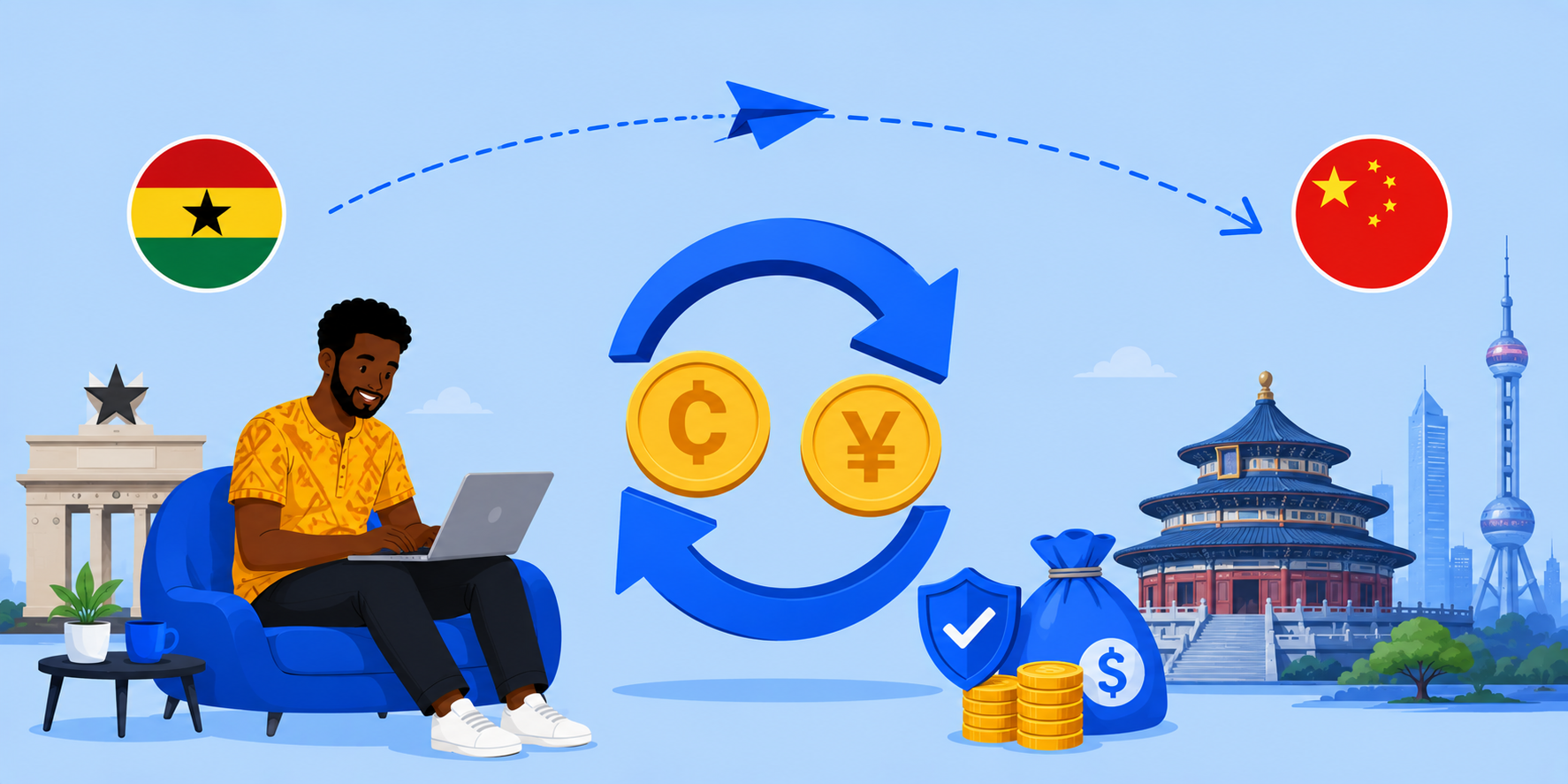
Every Ghanaian importer I have spoken to has a version of this story. The goods are ready at the factory in Guangzhou. Your supplier is following up by WhatsApp. And somewhere between your GCB account and their Yiwu bank, a wire transfer has disappeared into a fog of correspondent bank delays, compliance holds, and exchange rate losses that nobody warned you about.

I started hearing this from our users not long after Afriex launched its Ghana operations. The Nigeria-to-China corridor gets written about. But Ghanaian importers have been quietly navigating one of the more difficult payment corridors in West Africa with very little guidance. The traders who drive Kantamanto Market, the electronics distributors at Accra's tech hubs, the furniture suppliers feeding the construction boom in East Legon: all of them are working this out on their own.

Here is what I have learned, and what I would tell a friend starting their import business today.

The scale of Ghana-China trade, and why payments are the hidden bottleneck

Ghana imported approximately $3.5 billion worth of goods from China in 2023, making China Ghana's largest single import partner by a significant margin. Electronics, textiles, machinery, building materials, consumer goods. A substantial portion of what moves through Tema Port started in Yiwu or Guangzhou or Shenzhen.

But the payment side has never kept pace with the volume. The Ghanaian cedi has lost more than 60% of its value against the US dollar over the past four years, though it has stabilized somewhat in 2025 after IMF bailout tranches began arriving. The Bank of Ghana requires documentation for foreign currency transfers above certain thresholds. And Chinese suppliers increasingly prefer payment in yuan (RMB) rather than USD, which adds another conversion layer to an already expensive chain.

The result: most Ghanaian importers are paying more than they realize to move money to China, and many face delays that directly affect their supply chains and relationship with suppliers.

What most importers get wrong (it is not which bank they are using)

When I talk to new importers, the instinct is to walk into their commercial bank and do a SWIFT transfer. This works, eventually, but it is rarely the smartest option for several reasons.

SWIFT transfers from Ghana to China typically route through correspondent banks, usually a US or European intermediary. Each leg can add its own fee, and the total cost often runs between 3% and 6% of the transfer amount by the time you account for spread, transaction fees, and the conversion from cedis to USD to yuan. On a $10,000 order, that is up to $600 walking out the door before your supplier has touched the goods.

Documentation requirements from the Bank of Ghana for foreign exchange purchases above certain thresholds are also real. The paperwork is not impossible, but if you are a small importer making multiple payments per month, the friction compounds.

Then there is this part that catches people off guard: some commercial banks in Ghana simply do not have strong correspondent relationships with Chinese banks. Your transfer might sit in a queue for days before finding an onward route. I have spoken to importers who received calls from their supplier asking why payment had not arrived, only to find the wire was still sitting with an intermediary in New York.

The mistake is not using a bank. The mistake is assuming your bank has optimized this corridor for you, when in reality, international SWIFT transfers are a low-margin product that most commercial banks have not invested in improving.

Three categories of options worth knowing about in 2026

Three things are actually worth your time when you look at what Ghanaian businesses have available right now for paying Chinese suppliers.

SWIFT transfers through your commercial bank remain the most defensible option for large transactions, anything above $50,000, where a clean paper trail, documented exchange rate, and institutional accountability matter more than speed or cost. For Letters of Credit or large bulk orders where your supplier expects the funds to arrive with a SWIFT reference code, there is no real substitute. The cost is real but predictable.

Fintech transfer services are the sweet spot for regular importing payments, roughly $2,000 to $20,000 at a time. A licensed fintech that handles the GHS-to-CNY corridor directly can cut your effective costs significantly by converting without routing through USD as an intermediary. That middle conversion is where a lot of money silently disappears. Afriex handles cross-border transfers for Ghanaian users, though I would encourage you to compare options and look specifically at which services quote you an effective GHS-to-CNY rate versus asking you to work out two separate conversions yourself.

Stablecoin payment channels are emerging and worth watching closely right now. In June 2026, Flutterwave announced a partnership with Ripple that integrates RLUSD stablecoin into its cross-border payment infrastructure for Africa. Nigeria's SEC has also formally moved toward authorizing dollar-pegged stablecoins for cross-border trade settlements. For Ghanaian businesses already familiar with digital assets, USDT-based payment channels have offered transfer fees below 1%, which is a fraction of the typical SWIFT cost. The catch is that your Chinese supplier needs to be comfortable receiving and converting stablecoins, which varies by supplier size and sophistication. This option is becoming more practical but it is not yet plug-and-play for every supplier relationship.

The conversation you need to have with your supplier before paying anything

One pattern I see consistently: the importer picks a payment method without first asking the supplier what they actually prefer and what they can accept on their end.

Chinese suppliers in 2026 have genuinely different capabilities depending on their size and location. A large factory in Guangdong will likely accept USD via wire without issues. A mid-size supplier in Yiwu might strongly prefer WeChat Pay or Alipay, not because they are difficult, but because domestic yuan settlement is genuinely simpler for them than handling an incoming international wire.

The problem for Ghanaian importers is that WeChat Pay and Alipay officially require Chinese domestic bank accounts, which creates an obvious gap for foreign buyers. Some importers bridge this by paying a Chinese trade agent or consolidator who handles the final payment in yuan on their behalf. Others work with their supplier's specific bank to confirm the exact incoming wire details.

Before you set up any payment system, ask your supplier three questions directly. Do you prefer USD or RMB? What is your bank's full name and the province it is based in? Do you work with a trade agent for international buyers? Their answers will determine your best path more than any comparison guide.

What you are actually paying for when fees feel high

Fees are where most importers get frustrated, and I think they deserve a straighter answer than most comparison guides give them.

When you are moving money from Ghana to China, you are paying for more than the transfer itself. You are paying for speed, because your supplier may release goods before funds fully clear, and a delay costs you your production slot and sometimes your price lock. You are paying for documentation, because clean records matter for Tax Identification Number compliance and import duty calculations. And you are paying for recourse, because if something goes wrong with the transfer, who do you actually call?

The cheapest option is not always the right option. I would rather importers understand what they are buying than feel deceived by a service that looked cheap on fees but cost them a week of production delay.

A practical checklist before your next China payment

Confirm your supplier's exact bank name, account number, and SWIFT or BIC code before initiating anything. Chinese bank names are often transliterated differently depending on the region and the translating bank, and a small mismatch causes returns that take weeks to unwind.

Get your Bank of Ghana documentation in order before your transfer if the amount exceeds the threshold requiring FX purchase documentation. Your bank or fintech provider can tell you the current limit. Starting this process on the day you need to pay is too late.

Compare at least two services on the effective GHS-to-CNY rate, not just the stated fee. A service advertising "zero fees" but embedding a 4% spread on the exchange rate is more expensive than one charging a 1.5% fee at the mid-market rate. Do the total math before committing.

Ask your supplier directly whether they have received international payments from West African buyers before. Their answer tells you whether they have a working relationship with incoming wires or whether you are about to run into complications on their end of the transaction.

If you are using a fintech service for the first time, send a small test amount before dispatching a large order payment. The few hundred cedis this costs you as a test is cheap insurance against a routing issue you discover at the worst possible moment.

The bigger picture for Ghanaian importers

Ghana's trade relationship with China is not slowing down. The Belt and Road infrastructure investments, the commodity export relationships, and the sheer competitiveness of Chinese manufacturing in categories like electronics and textiles mean this corridor is only going to grow.

Behind the scenes, the infrastructure is catching up. Stablecoin regulation is maturing across West Africa. PAPSS, the Pan-African Payment and Settlement System backed by Afreximbank, has now processed over $1 billion in transactions and is expanding to more African countries, which may eventually enable yuan-adjacent settlement options for intra-African legs of these trade chains. Fintech companies are building more direct corridors rather than routing everything through USD intermediaries.

But right now, most Ghanaian importers are navigating this with outdated advice or none at all. The businesses that sort out their payment infrastructure early, and stop treating it as an afterthought after goods are already sitting at the factory, tend to move faster, negotiate better prices (suppliers treat reliable buyers differently), and avoid the cashflow crunches that come from unexpected transfer delays.

Your payment process is part of your supply chain, not an administrative chore that happens after the real work is done. The importers who understand that tend to have fewer emergency calls from their supplier asking where the money went.

Subscribe to the Afriex newsletter
Thank you! Your submission has been received!
Oops! Something went wrong while submitting the form.
TABLE OF CONTENT
Subscribe to our newsletter
Read about our privacy policy.
Thank you! Your submission has been received!
Oops! Something went wrong while submitting the form.

Every Ghanaian importer I have spoken to has a version of this story. The goods are ready at the factory in Guangzhou. Your supplier is following up by WhatsApp. And somewhere between your GCB account and their Yiwu bank, a wire transfer has disappeared into a fog of correspondent bank delays, compliance holds, and exchange rate losses that nobody warned you about.

I started hearing this from our users not long after Afriex launched its Ghana operations. The Nigeria-to-China corridor gets written about. But Ghanaian importers have been quietly navigating one of the more difficult payment corridors in West Africa with very little guidance. The traders who drive Kantamanto Market, the electronics distributors at Accra's tech hubs, the furniture suppliers feeding the construction boom in East Legon: all of them are working this out on their own.

Here is what I have learned, and what I would tell a friend starting their import business today.

The scale of Ghana-China trade, and why payments are the hidden bottleneck

Ghana imported approximately $3.5 billion worth of goods from China in 2023, making China Ghana's largest single import partner by a significant margin. Electronics, textiles, machinery, building materials, consumer goods. A substantial portion of what moves through Tema Port started in Yiwu or Guangzhou or Shenzhen.

But the payment side has never kept pace with the volume. The Ghanaian cedi has lost more than 60% of its value against the US dollar over the past four years, though it has stabilized somewhat in 2025 after IMF bailout tranches began arriving. The Bank of Ghana requires documentation for foreign currency transfers above certain thresholds. And Chinese suppliers increasingly prefer payment in yuan (RMB) rather than USD, which adds another conversion layer to an already expensive chain.

The result: most Ghanaian importers are paying more than they realize to move money to China, and many face delays that directly affect their supply chains and relationship with suppliers.

What most importers get wrong (it is not which bank they are using)

When I talk to new importers, the instinct is to walk into their commercial bank and do a SWIFT transfer. This works, eventually, but it is rarely the smartest option for several reasons.

SWIFT transfers from Ghana to China typically route through correspondent banks, usually a US or European intermediary. Each leg can add its own fee, and the total cost often runs between 3% and 6% of the transfer amount by the time you account for spread, transaction fees, and the conversion from cedis to USD to yuan. On a $10,000 order, that is up to $600 walking out the door before your supplier has touched the goods.

Documentation requirements from the Bank of Ghana for foreign exchange purchases above certain thresholds are also real. The paperwork is not impossible, but if you are a small importer making multiple payments per month, the friction compounds.

Then there is this part that catches people off guard: some commercial banks in Ghana simply do not have strong correspondent relationships with Chinese banks. Your transfer might sit in a queue for days before finding an onward route. I have spoken to importers who received calls from their supplier asking why payment had not arrived, only to find the wire was still sitting with an intermediary in New York.

The mistake is not using a bank. The mistake is assuming your bank has optimized this corridor for you, when in reality, international SWIFT transfers are a low-margin product that most commercial banks have not invested in improving.

Three categories of options worth knowing about in 2026

Three things are actually worth your time when you look at what Ghanaian businesses have available right now for paying Chinese suppliers.

SWIFT transfers through your commercial bank remain the most defensible option for large transactions, anything above $50,000, where a clean paper trail, documented exchange rate, and institutional accountability matter more than speed or cost. For Letters of Credit or large bulk orders where your supplier expects the funds to arrive with a SWIFT reference code, there is no real substitute. The cost is real but predictable.

Fintech transfer services are the sweet spot for regular importing payments, roughly $2,000 to $20,000 at a time. A licensed fintech that handles the GHS-to-CNY corridor directly can cut your effective costs significantly by converting without routing through USD as an intermediary. That middle conversion is where a lot of money silently disappears. Afriex handles cross-border transfers for Ghanaian users, though I would encourage you to compare options and look specifically at which services quote you an effective GHS-to-CNY rate versus asking you to work out two separate conversions yourself.

Stablecoin payment channels are emerging and worth watching closely right now. In June 2026, Flutterwave announced a partnership with Ripple that integrates RLUSD stablecoin into its cross-border payment infrastructure for Africa. Nigeria's SEC has also formally moved toward authorizing dollar-pegged stablecoins for cross-border trade settlements. For Ghanaian businesses already familiar with digital assets, USDT-based payment channels have offered transfer fees below 1%, which is a fraction of the typical SWIFT cost. The catch is that your Chinese supplier needs to be comfortable receiving and converting stablecoins, which varies by supplier size and sophistication. This option is becoming more practical but it is not yet plug-and-play for every supplier relationship.

The conversation you need to have with your supplier before paying anything

One pattern I see consistently: the importer picks a payment method without first asking the supplier what they actually prefer and what they can accept on their end.

Chinese suppliers in 2026 have genuinely different capabilities depending on their size and location. A large factory in Guangdong will likely accept USD via wire without issues. A mid-size supplier in Yiwu might strongly prefer WeChat Pay or Alipay, not because they are difficult, but because domestic yuan settlement is genuinely simpler for them than handling an incoming international wire.

The problem for Ghanaian importers is that WeChat Pay and Alipay officially require Chinese domestic bank accounts, which creates an obvious gap for foreign buyers. Some importers bridge this by paying a Chinese trade agent or consolidator who handles the final payment in yuan on their behalf. Others work with their supplier's specific bank to confirm the exact incoming wire details.

Before you set up any payment system, ask your supplier three questions directly. Do you prefer USD or RMB? What is your bank's full name and the province it is based in? Do you work with a trade agent for international buyers? Their answers will determine your best path more than any comparison guide.

What you are actually paying for when fees feel high

Fees are where most importers get frustrated, and I think they deserve a straighter answer than most comparison guides give them.

When you are moving money from Ghana to China, you are paying for more than the transfer itself. You are paying for speed, because your supplier may release goods before funds fully clear, and a delay costs you your production slot and sometimes your price lock. You are paying for documentation, because clean records matter for Tax Identification Number compliance and import duty calculations. And you are paying for recourse, because if something goes wrong with the transfer, who do you actually call?

The cheapest option is not always the right option. I would rather importers understand what they are buying than feel deceived by a service that looked cheap on fees but cost them a week of production delay.

A practical checklist before your next China payment

Confirm your supplier's exact bank name, account number, and SWIFT or BIC code before initiating anything. Chinese bank names are often transliterated differently depending on the region and the translating bank, and a small mismatch causes returns that take weeks to unwind.

Get your Bank of Ghana documentation in order before your transfer if the amount exceeds the threshold requiring FX purchase documentation. Your bank or fintech provider can tell you the current limit. Starting this process on the day you need to pay is too late.

Compare at least two services on the effective GHS-to-CNY rate, not just the stated fee. A service advertising "zero fees" but embedding a 4% spread on the exchange rate is more expensive than one charging a 1.5% fee at the mid-market rate. Do the total math before committing.

Ask your supplier directly whether they have received international payments from West African buyers before. Their answer tells you whether they have a working relationship with incoming wires or whether you are about to run into complications on their end of the transaction.

If you are using a fintech service for the first time, send a small test amount before dispatching a large order payment. The few hundred cedis this costs you as a test is cheap insurance against a routing issue you discover at the worst possible moment.

The bigger picture for Ghanaian importers

Ghana's trade relationship with China is not slowing down. The Belt and Road infrastructure investments, the commodity export relationships, and the sheer competitiveness of Chinese manufacturing in categories like electronics and textiles mean this corridor is only going to grow.

Behind the scenes, the infrastructure is catching up. Stablecoin regulation is maturing across West Africa. PAPSS, the Pan-African Payment and Settlement System backed by Afreximbank, has now processed over $1 billion in transactions and is expanding to more African countries, which may eventually enable yuan-adjacent settlement options for intra-African legs of these trade chains. Fintech companies are building more direct corridors rather than routing everything through USD intermediaries.

But right now, most Ghanaian importers are navigating this with outdated advice or none at all. The businesses that sort out their payment infrastructure early, and stop treating it as an afterthought after goods are already sitting at the factory, tend to move faster, negotiate better prices (suppliers treat reliable buyers differently), and avoid the cashflow crunches that come from unexpected transfer delays.

Your payment process is part of your supply chain, not an administrative chore that happens after the real work is done. The importers who understand that tend to have fewer emergency calls from their supplier asking where the money went.

Text Link

Lorem ipsum dolor sit amet, consectetur adipiscing elit. Suspendisse varius enim in eros elementum tristique. Duis cursus, mi quis viverra ornare, eros dolor interdum nulla, ut commodo diam libero vitae erat. Aenean faucibus nibh et justo cursus id rutrum lorem imperdiet. Nunc ut sem vitae risus tristique posuere.

Every Ghanaian importer I have spoken to has a version of this story. The goods are ready at the factory in Guangzhou. Your supplier is following up by WhatsApp. And somewhere between your GCB account and their Yiwu bank, a wire transfer has disappeared into a fog of correspondent bank delays, compliance holds, and exchange rate losses that nobody warned you about.

I started hearing this from our users not long after Afriex launched its Ghana operations. The Nigeria-to-China corridor gets written about. But Ghanaian importers have been quietly navigating one of the more difficult payment corridors in West Africa with very little guidance. The traders who drive Kantamanto Market, the electronics distributors at Accra's tech hubs, the furniture suppliers feeding the construction boom in East Legon: all of them are working this out on their own.

Here is what I have learned, and what I would tell a friend starting their import business today.

The scale of Ghana-China trade, and why payments are the hidden bottleneck

Ghana imported approximately $3.5 billion worth of goods from China in 2023, making China Ghana's largest single import partner by a significant margin. Electronics, textiles, machinery, building materials, consumer goods. A substantial portion of what moves through Tema Port started in Yiwu or Guangzhou or Shenzhen.

But the payment side has never kept pace with the volume. The Ghanaian cedi has lost more than 60% of its value against the US dollar over the past four years, though it has stabilized somewhat in 2025 after IMF bailout tranches began arriving. The Bank of Ghana requires documentation for foreign currency transfers above certain thresholds. And Chinese suppliers increasingly prefer payment in yuan (RMB) rather than USD, which adds another conversion layer to an already expensive chain.

The result: most Ghanaian importers are paying more than they realize to move money to China, and many face delays that directly affect their supply chains and relationship with suppliers.

What most importers get wrong (it is not which bank they are using)

When I talk to new importers, the instinct is to walk into their commercial bank and do a SWIFT transfer. This works, eventually, but it is rarely the smartest option for several reasons.

SWIFT transfers from Ghana to China typically route through correspondent banks, usually a US or European intermediary. Each leg can add its own fee, and the total cost often runs between 3% and 6% of the transfer amount by the time you account for spread, transaction fees, and the conversion from cedis to USD to yuan. On a $10,000 order, that is up to $600 walking out the door before your supplier has touched the goods.

Documentation requirements from the Bank of Ghana for foreign exchange purchases above certain thresholds are also real. The paperwork is not impossible, but if you are a small importer making multiple payments per month, the friction compounds.

Then there is this part that catches people off guard: some commercial banks in Ghana simply do not have strong correspondent relationships with Chinese banks. Your transfer might sit in a queue for days before finding an onward route. I have spoken to importers who received calls from their supplier asking why payment had not arrived, only to find the wire was still sitting with an intermediary in New York.

The mistake is not using a bank. The mistake is assuming your bank has optimized this corridor for you, when in reality, international SWIFT transfers are a low-margin product that most commercial banks have not invested in improving.

Three categories of options worth knowing about in 2026

Three things are actually worth your time when you look at what Ghanaian businesses have available right now for paying Chinese suppliers.

SWIFT transfers through your commercial bank remain the most defensible option for large transactions, anything above $50,000, where a clean paper trail, documented exchange rate, and institutional accountability matter more than speed or cost. For Letters of Credit or large bulk orders where your supplier expects the funds to arrive with a SWIFT reference code, there is no real substitute. The cost is real but predictable.

Fintech transfer services are the sweet spot for regular importing payments, roughly $2,000 to $20,000 at a time. A licensed fintech that handles the GHS-to-CNY corridor directly can cut your effective costs significantly by converting without routing through USD as an intermediary. That middle conversion is where a lot of money silently disappears. Afriex handles cross-border transfers for Ghanaian users, though I would encourage you to compare options and look specifically at which services quote you an effective GHS-to-CNY rate versus asking you to work out two separate conversions yourself.

Stablecoin payment channels are emerging and worth watching closely right now. In June 2026, Flutterwave announced a partnership with Ripple that integrates RLUSD stablecoin into its cross-border payment infrastructure for Africa. Nigeria's SEC has also formally moved toward authorizing dollar-pegged stablecoins for cross-border trade settlements. For Ghanaian businesses already familiar with digital assets, USDT-based payment channels have offered transfer fees below 1%, which is a fraction of the typical SWIFT cost. The catch is that your Chinese supplier needs to be comfortable receiving and converting stablecoins, which varies by supplier size and sophistication. This option is becoming more practical but it is not yet plug-and-play for every supplier relationship.

The conversation you need to have with your supplier before paying anything

One pattern I see consistently: the importer picks a payment method without first asking the supplier what they actually prefer and what they can accept on their end.

Chinese suppliers in 2026 have genuinely different capabilities depending on their size and location. A large factory in Guangdong will likely accept USD via wire without issues. A mid-size supplier in Yiwu might strongly prefer WeChat Pay or Alipay, not because they are difficult, but because domestic yuan settlement is genuinely simpler for them than handling an incoming international wire.

The problem for Ghanaian importers is that WeChat Pay and Alipay officially require Chinese domestic bank accounts, which creates an obvious gap for foreign buyers. Some importers bridge this by paying a Chinese trade agent or consolidator who handles the final payment in yuan on their behalf. Others work with their supplier's specific bank to confirm the exact incoming wire details.

Before you set up any payment system, ask your supplier three questions directly. Do you prefer USD or RMB? What is your bank's full name and the province it is based in? Do you work with a trade agent for international buyers? Their answers will determine your best path more than any comparison guide.

What you are actually paying for when fees feel high

Fees are where most importers get frustrated, and I think they deserve a straighter answer than most comparison guides give them.

When you are moving money from Ghana to China, you are paying for more than the transfer itself. You are paying for speed, because your supplier may release goods before funds fully clear, and a delay costs you your production slot and sometimes your price lock. You are paying for documentation, because clean records matter for Tax Identification Number compliance and import duty calculations. And you are paying for recourse, because if something goes wrong with the transfer, who do you actually call?

The cheapest option is not always the right option. I would rather importers understand what they are buying than feel deceived by a service that looked cheap on fees but cost them a week of production delay.

A practical checklist before your next China payment

Confirm your supplier's exact bank name, account number, and SWIFT or BIC code before initiating anything. Chinese bank names are often transliterated differently depending on the region and the translating bank, and a small mismatch causes returns that take weeks to unwind.

Get your Bank of Ghana documentation in order before your transfer if the amount exceeds the threshold requiring FX purchase documentation. Your bank or fintech provider can tell you the current limit. Starting this process on the day you need to pay is too late.

Compare at least two services on the effective GHS-to-CNY rate, not just the stated fee. A service advertising "zero fees" but embedding a 4% spread on the exchange rate is more expensive than one charging a 1.5% fee at the mid-market rate. Do the total math before committing.

Ask your supplier directly whether they have received international payments from West African buyers before. Their answer tells you whether they have a working relationship with incoming wires or whether you are about to run into complications on their end of the transaction.

If you are using a fintech service for the first time, send a small test amount before dispatching a large order payment. The few hundred cedis this costs you as a test is cheap insurance against a routing issue you discover at the worst possible moment.

The bigger picture for Ghanaian importers

Ghana's trade relationship with China is not slowing down. The Belt and Road infrastructure investments, the commodity export relationships, and the sheer competitiveness of Chinese manufacturing in categories like electronics and textiles mean this corridor is only going to grow.

Behind the scenes, the infrastructure is catching up. Stablecoin regulation is maturing across West Africa. PAPSS, the Pan-African Payment and Settlement System backed by Afreximbank, has now processed over $1 billion in transactions and is expanding to more African countries, which may eventually enable yuan-adjacent settlement options for intra-African legs of these trade chains. Fintech companies are building more direct corridors rather than routing everything through USD intermediaries.

But right now, most Ghanaian importers are navigating this with outdated advice or none at all. The businesses that sort out their payment infrastructure early, and stop treating it as an afterthought after goods are already sitting at the factory, tend to move faster, negotiate better prices (suppliers treat reliable buyers differently), and avoid the cashflow crunches that come from unexpected transfer delays.

Your payment process is part of your supply chain, not an administrative chore that happens after the real work is done. The importers who understand that tend to have fewer emergency calls from their supplier asking where the money went.

Related Articles

No items found.

Heading 1

Heading 2

Heading 3

Heading 4

Heading 5
Heading 6

Lorem ipsum dolor sit amet, consectetur adipiscing elit, sed do eiusmod tempor incididunt ut labore et dolore magna aliqua. Ut enim ad minim veniam, quis nostrud exercitation ullamco laboris nisi ut aliquip ex ea commodo consequat. Duis aute irure dolor in reprehenderit in voluptate velit esse cillum dolore eu fugiat nulla pariatur.

Block quote

Ordered list

  1. Item 1
  2. Item 2
  3. Item 3

Unordered list

Text link

Bold text

Emphasis

Superscript

Subscript