

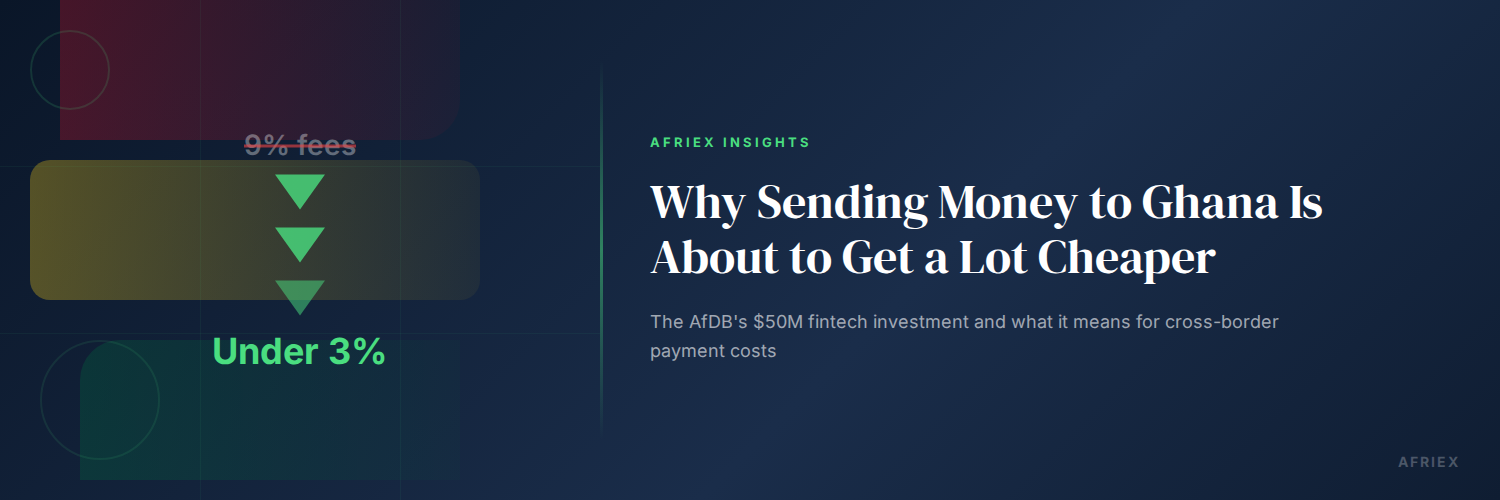

Last week, a friend in Accra sent me a screenshot of his bank statement. He'd received a wire transfer from a supplier in the UK, and by the time the correspondent bank fees, the FX markup, and the receiving bank's "processing charge" were deducted, nearly 9% of the original amount had vanished. Nine percent. On a $12,000 payment. That's over a thousand dollars that neither the sender nor the receiver agreed to pay.
I've been building cross-border payment infrastructure for years now, and stories like this still hit me. Not because they're surprising, but because they're so routine that most people have stopped questioning them.
But something shifted this month that could genuinely change the math for anyone sending money to Ghana.
The $50 Million Signal You Probably Missed
The African Development Bank quietly approved a $50 million financial inclusion and fintech innovation package for Ghana in April 2026. If you blinked, you missed it. Most of the coverage treated it as another institutional press release, the kind that gets filed under "nice to know" and forgotten.
I read it differently.
This package isn't just about handing money to banks. A significant portion is earmarked for fintech infrastructure, specifically the kind of digital payment rails that reduce the cost of moving money into and around Ghana. We're talking about interoperability upgrades, mobile money expansion, and support for the regulatory sandbox that the Bank of Ghana has been quietly building.
Why does this matter for someone sending money from Houston or London to Accra? Because the cost of a cross-border transfer isn't really about the transfer itself. It's about the infrastructure on both ends. When the receiving country has fragmented, analog payment rails, every intermediary adds a fee. When those rails get upgraded, fees compress. It's that simple, and it's that slow, which is why most people haven't noticed the shift yet.
What's Actually Driving Costs Down
Let me break down where your money goes when you send a payment to Ghana today.
The first layer is the FX conversion. The cedi has been on a turbulent ride. In the first quarter of 2026 alone, it fluctuated by over 8% against the dollar. That volatility isn't just a headline number. It means that the rate you're quoted when you initiate a transfer and the rate that's actually applied when the funds settle can be materially different. Banks and traditional remittance providers bake in a cushion for this, sometimes 2-3% on top of whatever spread they're already charging.
The second layer is the correspondent banking chain. A payment from a US bank to a Ghanaian bank typically passes through one or two intermediary banks, each of which takes a cut. This is the part of the system that's most visibly broken, and also the part where fintech rails are making the biggest dent.
The third layer is the last mile. Getting cedis into the hands of the recipient, whether through a bank account, mobile money wallet, or cash pickup, costs money too. Ghana's mobile money ecosystem is more developed than many people outside the continent realize. MTN MoMo alone processes billions of cedis monthly. But connecting that ecosystem to international payment flows has been clunky.
The AfDB package targets all three layers, but especially the second and third. More interoperable domestic rails means fewer intermediaries needed to complete a cross-border payment. That's not theory. We've watched it play out in Kenya, where M-Pesa's integration with international corridors brought remittance costs down from an average of 8.9% in 2019 to under 5% today.
The Cedi Factor
I can't talk about sending money to Ghana without addressing the elephant in the room. The cedi's depreciation has been painful. If you're a business paying suppliers in Ghana, you've felt this as a slow, compounding cost increase that shows up in every invoice. If you're in the diaspora sending money home, you've watched the purchasing power of your transfers erode.
There's a counterintuitive dynamic here, though. When a currency depreciates, the relative cost of remittance fees (as a percentage of the amount received) actually increases for the recipient, even if the nominal fee stays flat. A $7 fee on a $200 transfer is 3.5%. But if the cedi weakens and the recipient needs you to send $220 to cover the same expenses, that $7 is now eating into a tighter budget.
This is why infrastructure improvements matter more during periods of currency stress, not less. Every percentage point saved on transfer fees has outsized impact when the receiving currency is under pressure.
The Bank of Ghana has also been tightening its FX framework, pushing more transactions onto formal, digital channels where rates are more transparent. This is partly a stability measure, partly a data play, and partly a recognition that informal FX channels, while popular, introduce risks and costs that ultimately hurt consumers.
What Most Businesses Still Get Wrong About Ghana Payments
I talk to businesses every week that are moving money into Ghana, whether for payroll, supplier payments, or investment repatriation. The mistake I see most often is treating the payment as a banking problem when it's actually a routing problem.
What I mean is this: most companies default to their existing bank's wire transfer service because it's familiar. They fill out the SWIFT form, they eat the $35-50 wire fee plus the FX spread, and they assume that's just what it costs. They never question the route.
But the route matters enormously. A payment that goes through a correspondent banking chain with two intermediaries and settles in 3-5 business days will cost dramatically more, in both fees and FX slippage, than a payment routed through modern fintech rails that settle in hours or minutes. The liquidity path, the settlement speed, and the number of intermediaries are the variables that determine your actual cost, not the headline "transfer fee" that most providers advertise.
I've seen businesses save 4-6% per transaction simply by switching from traditional wire transfers to digital payment platforms that use direct corridors. On a company sending $50,000 a month to Ghanaian suppliers, that's $2,000-3,000 in monthly savings. That's real money.
The second mistake is ignoring the timing dimension. With a volatile currency like the cedi, when your payment converts and settles can be as important as the fee you're paying. A service that quotes you a rate and locks it in for the duration of the transfer is fundamentally different from one that applies the rate at the time of settlement, which might be days later. Most people don't think to ask which model their provider uses until they've already been burned by it.
PAPSS and the Pan-African Angle
There's a broader structural shift happening that intersects with the Ghana story. The Pan-African Payment and Settlement System, PAPSS, has been gradually onboarding more countries and currencies. Ghana was one of the early participants, and the cedi is actively traded on the platform.
PAPSS matters because it allows payments between African countries to settle in local currencies without routing through the dollar or euro. For intra-African trade, this is transformative. But it also has implications for diaspora payments, because it creates additional liquidity pools and settlement pathways that can be leveraged by fintechs building cross-border corridors.
We're still in the early innings. PAPSS transaction volumes are growing but remain a fraction of total cross-border flows. But the infrastructure is there, and every new country and currency that joins the network makes the math better for everyone.
What You Can Do Right Now
If you're regularly sending money to Ghana, whether personal remittances or business payments, there are concrete steps you can take today to pay less.
Start by getting clarity on your actual costs. Not just the transfer fee, but the full cost: the FX markup versus the mid-market rate, any intermediary bank charges, and any receiving fees on the Ghana end. Most people are shocked when they add it all up. I've met people who thought they were paying 1% and discovered it was closer to 5% when you included the FX spread.
Compare multiple providers for your specific corridor. The cheapest option for US-to-Ghana is not necessarily the cheapest for UK-to-Ghana or Canada-to-Ghana. Corridor economics vary based on liquidity, partnerships, and regulatory overhead.
Look at settlement speed as a cost factor. If you're making a business payment and the cedi moves 1% during a 3-day settlement window, that's an invisible fee that won't show up on any receipt. Faster settlement, even if it carries a slightly higher nominal fee, can be cheaper in total cost.
We built Afriex to address exactly these pain points, direct corridors, transparent FX, fast settlement. But I'd encourage you to compare options and find what works best for your specific use case. The important thing is to stop accepting legacy banking costs as inevitable.
Where This Is Heading
The $50 million AfDB investment is a signal, not a solution. It's going to take years for the full impact to show up in lower consumer and business costs. But the trajectory is clear.
Ghana's payment infrastructure is being upgraded. Mobile money interoperability is expanding. Regulatory frameworks are maturing. And fintech companies are building direct corridors that bypass the correspondent banking chain entirely.
I think about my friend in Accra and that 9% haircut on his wire transfer. That number is going to come down. Not overnight, and not evenly across all corridors and providers. But the structural changes are real, and they're accelerating.
The question isn't whether cross-border payments to Ghana will get cheaper. It's whether you'll still be overpaying while the infrastructure catches up, or whether you'll switch to the providers that are already routing around the bottlenecks.




.svg)
.svg)
.svg)
.svg)
.svg)
.svg)
.svg)
.svg)
.svg)
.svg)
.svg)
.svg)
.svg)
.svg)
.svg)
.svg)
.svg)
.svg)
.svg)
.svg)
.svg)
.svg)
.svg)
.svg)
.svg)
.svg)
.svg)
.svg)
.svg)
.svg)
.svg)
.svg)
.svg)
.svg)
.svg)
.svg)
.svg)
.svg)
.svg)
.svg)
.svg)
.svg)
.svg)
.svg)
.svg)
.svg)


.png)

.png)